Production Wrap Checklist: What Every AD Hands Off
Wrap & Delivery
Everyone claps when the last scene wraps. The AD department still has a checklist: a DOOD that has to reconcile, a wrap notice, and a call sheet that has to go out anyway.
Picture wrap looks like the easy part. The last scene is in the can, somebody hands the director flowers, and the crew heads home. For the AD department, wrap is also a production wrap checklist with real deadlines: a DOOD that has to reconcile, a wrap notice, and a call sheet that still has to go out.
Nobody teaches the wrap side the way they teach the schedule side. You learn the stripboard and the DOOD in prep. Nobody hands you the list of what still has to be right on the way out the door, so most ADs improvise it from memory, and memory is exactly what goes first on a long day.
This guide is the production wrap checklist the AD department actually runs: what wrap means for cast versus crew versus the whole show, the wrap-day call sheet annotated section by section, what the union rules still require after the cameras stop, and the independent checklist to run before you hand the paperwork off.
What a Production Wrap Checklist Actually Covers
Wrap is not one moment. It happens three different ways on the same show, and the AD department is the only department that has to track all three at once, which is exactly why the department runs its own checklist instead of borrowing someone else's.
A cast member can be wrapped in week two of a six-week shoot and never set foot on location again. A department can be wrapped days before picture wrap if their scenes finish early. Picture wrap, the one everyone claps for, is just the day the last of those individual wraps finally lines up.
The reason this matters to the AD department specifically: the schedule and the DOOD stay live legal and payroll documents right up until every one of those individual wraps is confirmed and reconciled, not until the last shot is called.
The Production Wrap Checklist, Step by Step
Work this in order. Each step depends on the one before it, and doing them out of order is how a hold day gets coded as a drop or a finish date gets missed on the way out.
Confirm every actor's finish day before you confirm the show's
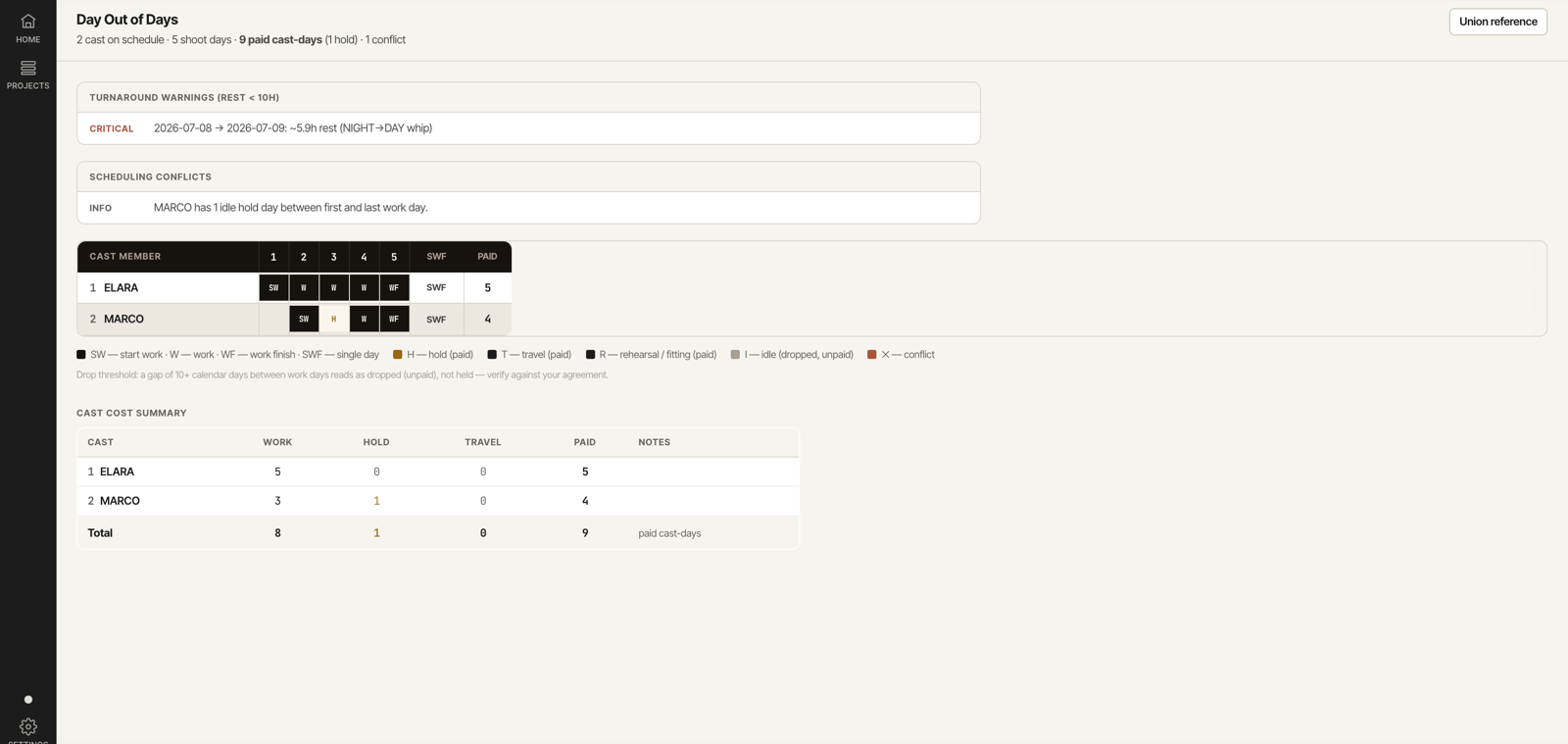
Walk the DOOD start to finish and check every WF against the actual last day that actor appears on the board, not the day you originally planned for them.
Send wrap notices under the same rest rules as every other day
A wrap notice tells an actor or a department they're released. It still has to respect the notice period and turnaround owed under the contract in effect, union or not.
Build the last-day call sheet like it's still day one
Call times, weather, nearest hospital, department calls: none of it gets to be informal because the schedule is almost over. The people on it still need to know where to be.
Reconcile hold days against the finish dates you just confirmed
A gap in an actor's schedule you coded as a paid hold has to actually resolve to a real finish day. An open hold with no finish behind it is a payroll question waiting to happen.
Lock the schedule before anything gets struck
Save a snapshot of the final board before gear comes down. Once a location is struck you cannot go back and check what the plan actually was that day.
Hand off the wrap package
Final DOOD, final schedule, cast and crew contact sheets, the call sheet archive. One folder, handed to the UPM or production office, not five people each holding one piece.
The Wrap-Day Call Sheet, Annotated
The last-day call sheet does the same job as every other one, with a handful of sections that only show up on this specific day. Miss them and the crew finds out you're wrapping from a rumor instead of from the document that's supposed to tell them.
Reference · Anatomy
The wrap-day call sheet, section by section
| Sc# | Set | D/N | Pgs | Cast |
|---|---|---|---|---|
| 104 | EXT · CLIFF PATH | D2 | 2 1/8 | 1, 3 |
| Company move · to Lighthouse Interior | ||||
| 106 | INT · LIGHTHOUSE | D2 | 1 4/8 | 1, 2, 4 |
| # | Cast | Role | P/U | H/MU | Set | Status |
|---|---|---|---|---|---|---|
| 1 | J. Calloway | MAREN | 5:15a | 5:45a | 7:00a | WF |
| 3 | T. Wren | DEV | 5:15a | 5:45a | 7:00a | WF |
| Sc# | Set | D/N | Pgs |
|---|---|---|---|
| Picture wrap. Strike begins immediately after last shot. |
- 1Header blockSame production info as always, marked Day 21 of 21 so nobody has to ask.
- 2The reminders barThis is where a wrap day actually announces itself: who is wrapping, what gets returned, and where.
- 3Cast status columnA Status column marking WF (work finish) tells every department who is done today without cross-checking the DOOD.
- 4Advance schedule, replacedThere is no next day to advance. This slot carries the strike notice instead, so nobody assumes it's a formatting mistake.
- 5NotesEquipment return instructions belong here, not in a group text sent after half the crew has already left.
Everything else on the sheet, weather, hospital, department calls, stays exactly as accurate as it would on a normal call sheet. A wrap day is still a shoot day until the last shot is actually called.
What Still Applies Under SAG-AFTRA at Wrap
The rules that governed every other day of the shoot do not soften because the schedule is ending. Two of them trip up ADs specifically at wrap, because it's easy to assume the last day is informal.
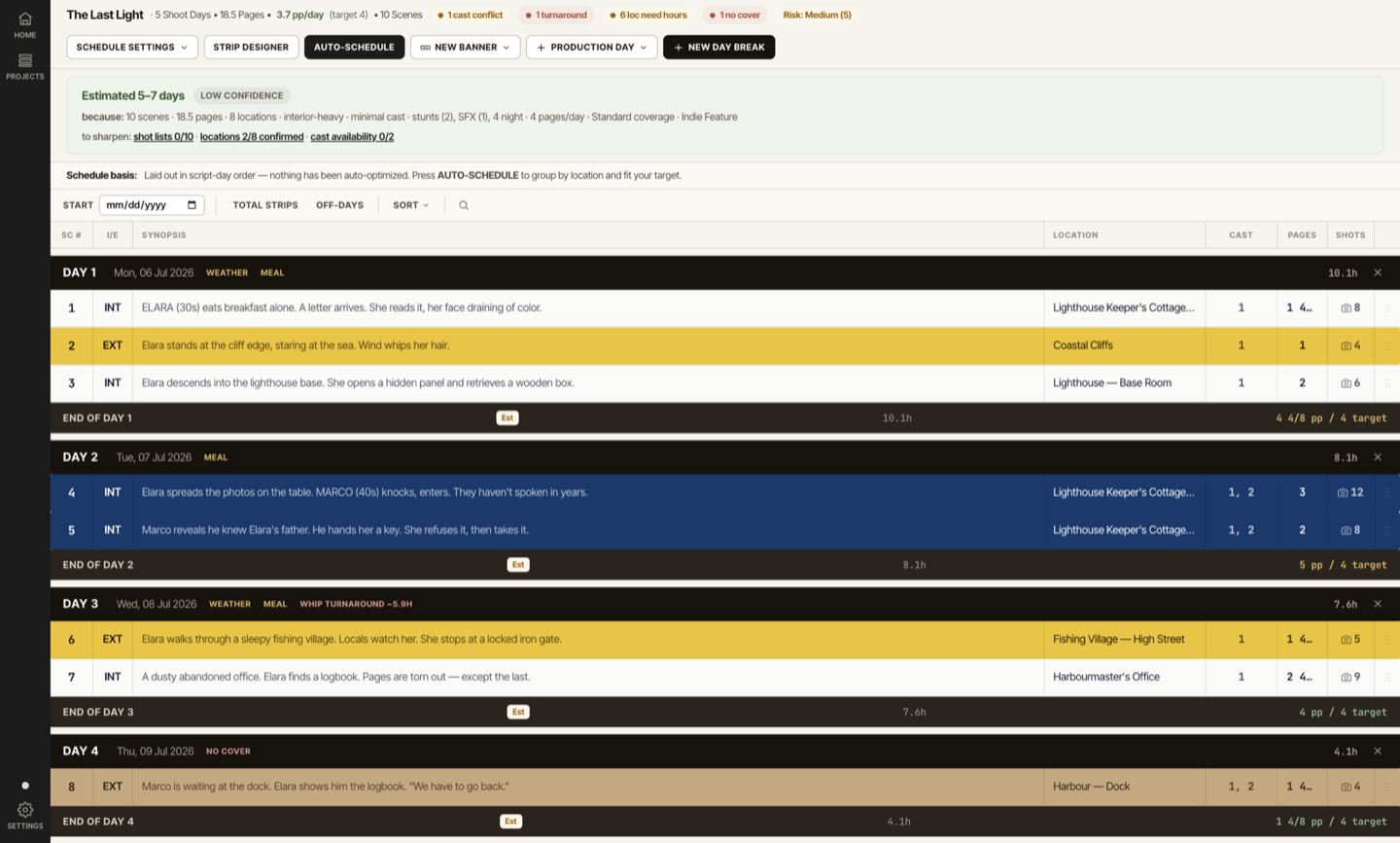
Turnaround still applies to a performer's last night on the show the same way it applied to their first. If the schedule calls them back for anything, ADR notification, a reshoot day, a pickup, the rest owed between their wrap and that call is calculated exactly the same way.
The other one: meal penalties and turnaround violations on the actual last day still count. A short rest gap or a missed meal on day 21 costs exactly what it would have cost on day 3. Nothing about the calendar excuses it.
The Final Handoff Checklist
Run this before you consider the AD department's part of wrap done. Order doesn't matter here, completeness does, which is why it's a checklist and not a sequence.
- Every actor on the DOOD has a finish date that matches the actual last day they appear on the board
- Every hold day resolves to a real finish, none left open with no date behind it
- The final schedule is saved as a locked snapshot, not just the last live version of the board
- Cast and crew contact sheets are exported and included in the handoff
- The full call sheet archive for the show is complete and handed to the production office
- Any open red flag from the run of the show is either resolved or explicitly logged as an accepted risk, not just forgotten
Wrap Mistakes Worth Avoiding
- Coding a hold as a drop, or the reverse. One is paid, the other isn't. Get this wrong on the way out and it's a payroll correction weeks after the actor has moved on to another job.
- Sending the wrap notice too late for the contract's window. Drop-and-pickup and consecutive-employment provisions key off the notice date, not the day you happened to mention it on set.
- Treating the last call sheet as a formality. It's the document the crew is actually using to get to set that day. Weather, hospital, and call times still have to be right.
- Losing the schedule the moment the board is struck. Once the live stripboard is gone, a locked snapshot from the day before is the only proof of what the plan actually was.
Free Production Wrap Checklist
If you're running wrap off a printed list, start from the checklist above instead of a blank page: DOOD reconciliation, wrap notices, the last-day call sheet, and the final handoff, in the order that catches a mistake before it's expensive.
It's the same list the software checks automatically as your schedule fills in. Move from a printed checklist to a tool later and the checklist itself doesn't change, only how much of it you're doing by hand.
Production Wrap Checklist FAQ
What does "wrap" mean on a film set? It depends on the scope. A company wrap ends one shoot day. A cast or crew wrap is one person's last day on the show. Picture wrap is the whole production: every scene shot, no further photography planned.
Who owns the wrap checklist, the AD or the UPM? The AD department owns the schedule side: DOOD reconciliation, wrap notices, and the final call sheet. The UPM or production office typically owns the broader wrap book, contracts, receipts, and department-wide paperwork. Both need the AD department's pieces to close their own checklist out.
Does turnaround still apply on the last day of shooting? Yes. Rest and meal-period rules apply to every day a performer or crew member is called, including the last one and any pickup or ADR day scheduled after wrap.
What is a wrap notice and when does it have to go out? It's the formal notice that an actor or department is released from the schedule. The lead time it has to respect depends on the specific contract's drop-and-pickup and consecutive-employment terms, so check the signed agreement rather than assuming a standard number.
What's the difference between wrap paperwork and a DOOD? The DOOD tracks every cast member's status, including their finish day, for the whole run of the show. Wrap paperwork is broader: the DOOD plus the final schedule, contact sheets, and call sheet archive that get handed off once the DOOD itself is confirmed correct.
Can AD PrePro help with wrap paperwork? Yes, for the AD department's part of it. AD PrePro keeps the DOOD reconciled against the live schedule, lets you lock a snapshot of the final board, and exports the cast and crew contact sheets and call sheet archive as part of its reports. It does not handle contracts, timecards, or payroll.
Close the Show the Way You Ran It
You now have the actual production wrap checklist: reconcile the DOOD against real finish dates, respect the same rest rules on the way out that applied on the way in, get the last call sheet right, and hand off one complete package instead of five scattered files.
AD PrePro keeps the DOOD reconciled against your schedule the whole way through, so wrap week is a confirmation instead of a reconstruction. Build it once, trust it through the last day, and hand off a wrap package that actually matches what happened.