How to Make a Call Sheet: The Version ADs Actually Use
Call Sheets
A call sheet looks like a list. What it actually is: call times worked backward from the first shot, under a deadline, with fifty people's mornings riding on the math being right.
A call sheet sounds simple. It's a list of who shows up where and when. The problem is that those details come from seventeen different people, two of whom have conflicting information, and the whole thing is due in your director's inbox by 7pm.
This guide covers how to build a call sheet the way a working 2nd AD does it: every section in order, the back-timing math that sets each call time, the walkie-channel convention, and the revision habit that keeps a same-day change from stranding half the crew. Plus a free template you can use tonight.
What a Call Sheet Actually Does
A call sheet is the single document that tells every department where to be, when, and why, for one specific shoot day. It's built from the shooting schedule and the day's scenes, but it's a different document with a different job: the schedule plans the show, the call sheet runs tomorrow.
Everyone on a union or non-union set gets one: cast, crew, background, vendors. Most productions send it out the evening before, as a PDF, so people can plan their morning around it. Get it wrong and the mistake shows up as an actor standing in the wrong parking lot at 5am.
Every Section, In Order
A call sheet has a standard shape. Productions vary the layout, but almost everything below shows up on every one you will ever build or read. Here is the front page of one, with every section numbered.
Reference · Anatomy
The front page of a call sheet
| Sc# | Set | D/N | Pgs | Cast |
|---|---|---|---|---|
| 12 | INT · LIGHTHOUSE STAIR | N1 | 1 3/8 | 1, 3 |
| 12A | INT · LANTERN ROOM | N1 | 6/8 | 1 |
| Company move · Lighthouse to Cliff Path (0.4 mi, 15 min) | ||||
| 9 | EXT · CLIFF PATH | N1 | 2 2/8 | 1, 3, 4 |
| 9A | EXT · CLIFF PATH (INSERT) | N1 | 3/8 | 1 |
| # | Cast | Role | P/U | H/MU | Set |
|---|---|---|---|---|---|
| 1 | J. Calloway | MAREN | 5:45a | 6:15a | 7:30a |
| 3 | T. Osei | WILL | 6:00a | 6:30a | 7:30a |
| 4 | L. Park | DEPUTY | O/C | — | 11:00a |
| # | Description | Call |
|---|---|---|
| 4 | Stand-ins (2) | 6:30a |
| 5 | Atmosphere · townsfolk (6) | 9:00a |
| Sc# | Set | D/N | Pgs |
|---|---|---|---|
| 21 | INT · KEEPER COTTAGE | D1 | 2 4/8 |
| 22 | EXT · DOCK | D1 | 1 1/8 |
- 1Header blockProduction, unit, shoot date, and Day X of Y. The identity of this one specific day.
- 2General crew callThe single time the whole day is built around, plus the first shooting call.
- 3Key peopleDirector, producer, UPM, and the AD team, so anyone can reach whoever runs the day.
- 4Key locationsSet, production office, crew parking, basecamp, and the nearest hospital.
- 5Today's key timesBreakfast, crew call, shooting call, lunch, and estimated wrap, at a glance.
- 6Weather and sunForecast, wind, sunrise and sunset, and golden hour if the day depends on it.
- 7Reminders barThe short safety and set-etiquette line every department needs to see first.
- 8Today's scheduleEach scene in shooting order, with a COMPANY MOVE row wherever the unit relocates.
- 9Cast callsEach actor's pickup, hair and makeup, and time to set, back-timed from the first shot.
- 10Extras and stand-insBackground and stand-in numbers and call times, kept separate from principal cast.
- 11Department notesThe specific ask per department: camera, grip and electric, art, and the rest.
- 12Advance scheduleTomorrow's sets, day or night, and page count, so people can plan tonight.
- 13Notes and mealsMeal-penalty clock, turnaround, and where to find the walkie channel map.
| Section | What Goes In It |
|---|---|
| Header | Production name, the date, "Day X of Y," and contact info for the director, producer, UPM, and 1st AD |
| General Crew Call | The single time the whole show is built around, set large and impossible to miss |
| Weather & Astronomical | Forecast, high and low, sunrise and sunset, golden hour if the day depends on it |
| Locations & Hospital | Set address, parking, basecamp, and the nearest hospital for every location shooting that day |
| Scene Schedule | Scene number, INT/EXT, D/N, set, a one-line description, the cast in it, and page count |
| Cast & Day Players | Each actor's character name, call time, time to set, and hair/makeup/wardrobe status |
| Department Calls | A call time for every department: camera, grip, electric, sound, art, wardrobe, and the rest |
| Advance Schedule | A look-ahead at tomorrow's sets and cast, so people can plan tonight |
| Notes | Walkie channels, safety reminders, meal info, and anything a department needs flagged |
The Back-Timing Math Behind Every Call Time
Here's the part film school skips. Every call time on the sheet is worked backward from a single fixed point: the time the camera actually needs to be rolling on the first shot. That's back-timing, and it's subtraction, not guesswork.
Start with the first shot time. Ask what has to be finished before it, and how long that takes. Subtract, department by department, until you have a call time for everyone.
Set the general crew call
First shot time, minus the setup the location and lighting need. If the first shot is 8:00am and electric needs 90 minutes to rig, crew call is 6:30am.
Back-time each cast call
On-set time, minus hair, makeup, and wardrobe, minus the walk to set. An actor who needs 45 minutes in the chair and a 10-minute walk gets called for 7:05am against an 8:00am first shot.
Call the early departments ahead
Art department, set dressing, and anyone prepping the location get called before general crew call, because their work has to be done before anyone else arrives.
There's one more constraint sitting underneath all of it: nobody's call time can violate their required rest from the day before. If an actor's turnaround from last night's wrap doesn't clear the call time the math above just gave you, the math loses. Move the call time later, or you've booked a forced call before the day even starts.
Here's what that looks like worked all the way through, for an 8:00am first shot:
| Call Time | Who | Why |
|---|---|---|
| 5:45am | Art department / set dressing | Needs the set finished before anyone else walks in |
| 6:30am | General crew (grip, electric, camera) | 90 minutes to rig before the first shot |
| 7:05am | Lead cast | 45 minutes in hair/makeup/wardrobe, plus a 10-minute walk to set |
| 7:45am | 2nd AD / PAs | On hand for breakfast and to direct crew as they arrive |
| 8:00am | Camera rolling | The fixed point everything else was subtracted from |
Notice the order: the departments that need the most lead time get called first, and the fixed point (first shot) never moves. Everything else is negotiable until the math stops working, and then you move the fixed point instead of pretending the math still holds.
A call sheet is a countdown. The last number you set is the one fifty people plan their morning around.
Walkie Channels: The Convention Nobody Officially Owns
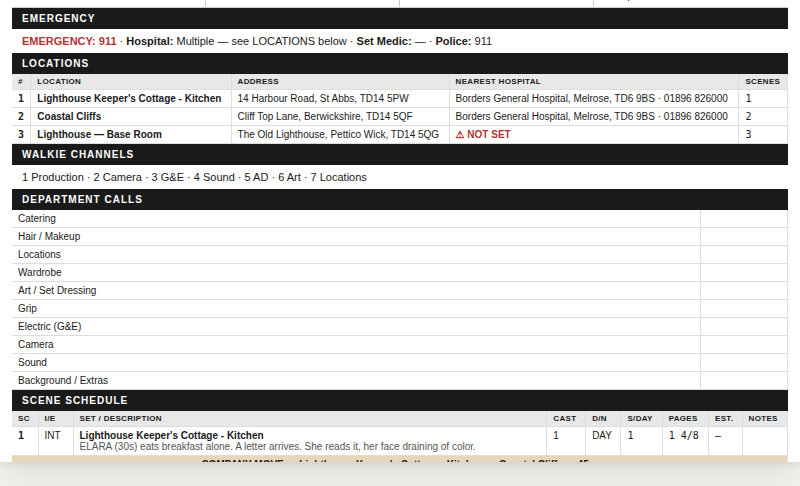
Every set uses walkies, and every set assigns channels by department so twelve conversations aren't stepping on each other. There's a common convention, not a fixed rule, and it changes by region and by production.
| Channel | Typical Department |
|---|---|
| 1 | 1st AD, production, and the departments that need to hear the AD run the set |
| 2 | Camera |
| 3 | Grip & Electric |
| 4 | Sound |
| 5 | Art / Set Dressing |
| 6 | Locations |
| 7+ | Special departments: stunts, SFX, background, security |
Rev A, B, C: Not the Same Thing as Script Revisions
A call sheet carries its own revision letter. The first version out is the base sheet. If anything changes after it goes out (a location swap, a call time moving, weather flipping a scene from exterior to cover set) you reissue it as Rev A, then Rev B, then Rev C, each one dated and distributed again.
Don't confuse this with the script's revision colors, the white/blue/pink sequence that tracks which draft of the script a page belongs to. Same word, completely different document. A call sheet's Rev A/B/C only tracks changes to tomorrow's call sheet, and it resets every shoot day.
The habit that matters: the moment you change anything on a distributed call sheet, bump the revision and redistribute. A crew working off an un-bumped sheet is working off information you already know is wrong.
Where the Call Sheet's Data Should Come From
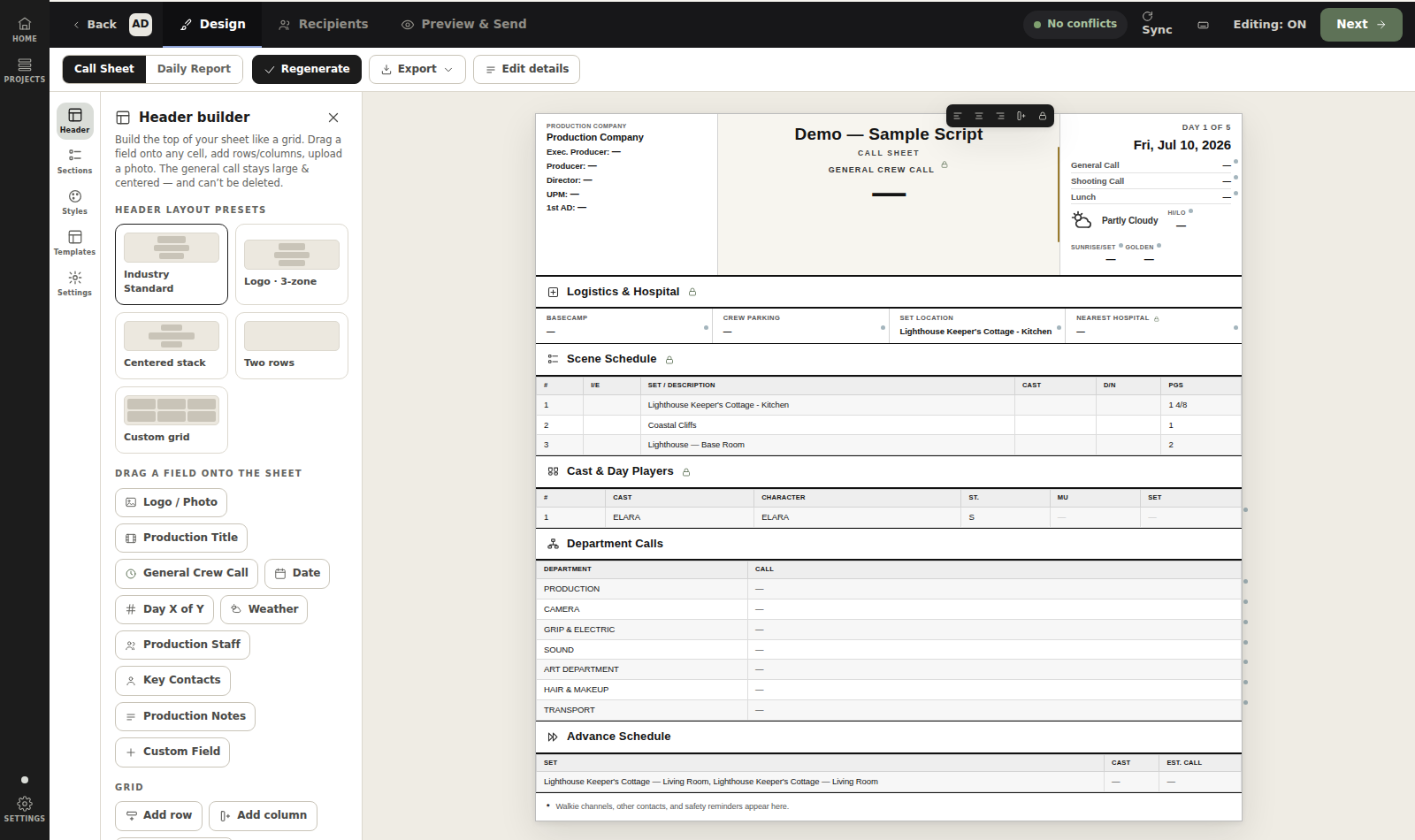
A call sheet built from scratch every night is a call sheet built from memory, and memory is where wrong call times come from. Everything on it already exists somewhere: the scenes and cast came out of your breakdown, the day's order came out of the schedule, the location details came out of your location file.
The reliable version pulls from those sources instead of re-typing them. Change a scene's location once, upstream, and the call sheet for that day should already know about it instead of shipping the old address because nobody remembered to update three documents.
Mistakes That Wreck a Call Sheet
None of these are exotic. They're the same five mistakes, over and over, on shows that should know better.
- Sending it too late. Crew plan their morning around this document. Late means people find out about a location change on the drive there.
- An unconfirmed hospital address. "We'll figure it out" is not an acceptable answer to "where's the nearest ER," ever.
- Copy-pasting last night's weather. A forecast a day stale is worse than no forecast, because it reads as current.
- Changing a call time without bumping the revision. Half the crew works off the old PDF in their email. Now two versions of the truth exist on one set.
- Assuming everyone reads the whole page. Bold the general crew call, the address, and the emergency numbers. Those three things have to survive a skim.
Before a call sheet leaves your outbox, three things have to survive a skim and a bad night of sleep. Run them every single time.
- One general crew call, set large and impossible to miss
- The nearest hospital confirmed, on the sheet and on the map
- An advance schedule, so cast and crew can plan tonight
Free Call Sheet Template
If you're building call sheets by hand, start from a real one instead of a blank page. Our free call sheet template lays out every section above in the standard order, with the header, weather, locations, scene schedule, and department calls already structured for you.
It's the same structure the software builds automatically, so if you move from a template to a tool later, nothing about how you think through a call sheet has to change.
Call Sheet FAQ
Who makes the call sheet on a film set? Usually the 2nd AD builds it, pulling call times, locations, and scenes from the schedule the 1st AD owns. On smaller productions the 1st AD sometimes builds it directly.
What is the difference between a call sheet and a shooting schedule? The shooting schedule plans the whole show, scene by scene, across every shoot day. The call sheet is the one-day execution document built from it: who shows up, where, and when, for tomorrow only.
How do you calculate call times on a call sheet? Work backward from the first shot of the day. Subtract setup time for crew, hair/makeup/wardrobe plus travel-to-set time for cast, and check that no one's call time violates their required rest from the day before.
What does Rev A, B, or C mean on a call sheet? It marks how many times that specific day's call sheet has been reissued after a change. Rev A is the first change after the original, Rev B the second, and so on. It resets every shoot day.
When should a call sheet go out? The evening before the shoot day, early enough for cast and crew to plan around it. Same-day changes still happen; that's what the revision letter is for.
Can software generate a call sheet automatically? Yes, if it already has your schedule and breakdown, a tool can back-time call times, pull in weather, and lay out every section for you. You still review it. A wrong call time is not a bug you want to discover on set.
Build It Once, Send It With Confidence
You now have the whole method: every section in order, the back-timing math behind each call time, the walkie convention, and the revision habit that keeps a same-day change from stranding anyone.
AD PrePro builds the call sheet from the schedule and breakdown you already have in the app, back-times the calls, pulls in the weather, and bumps the revision for you when something changes. Upload a script and the first call sheet is already most of the way built.