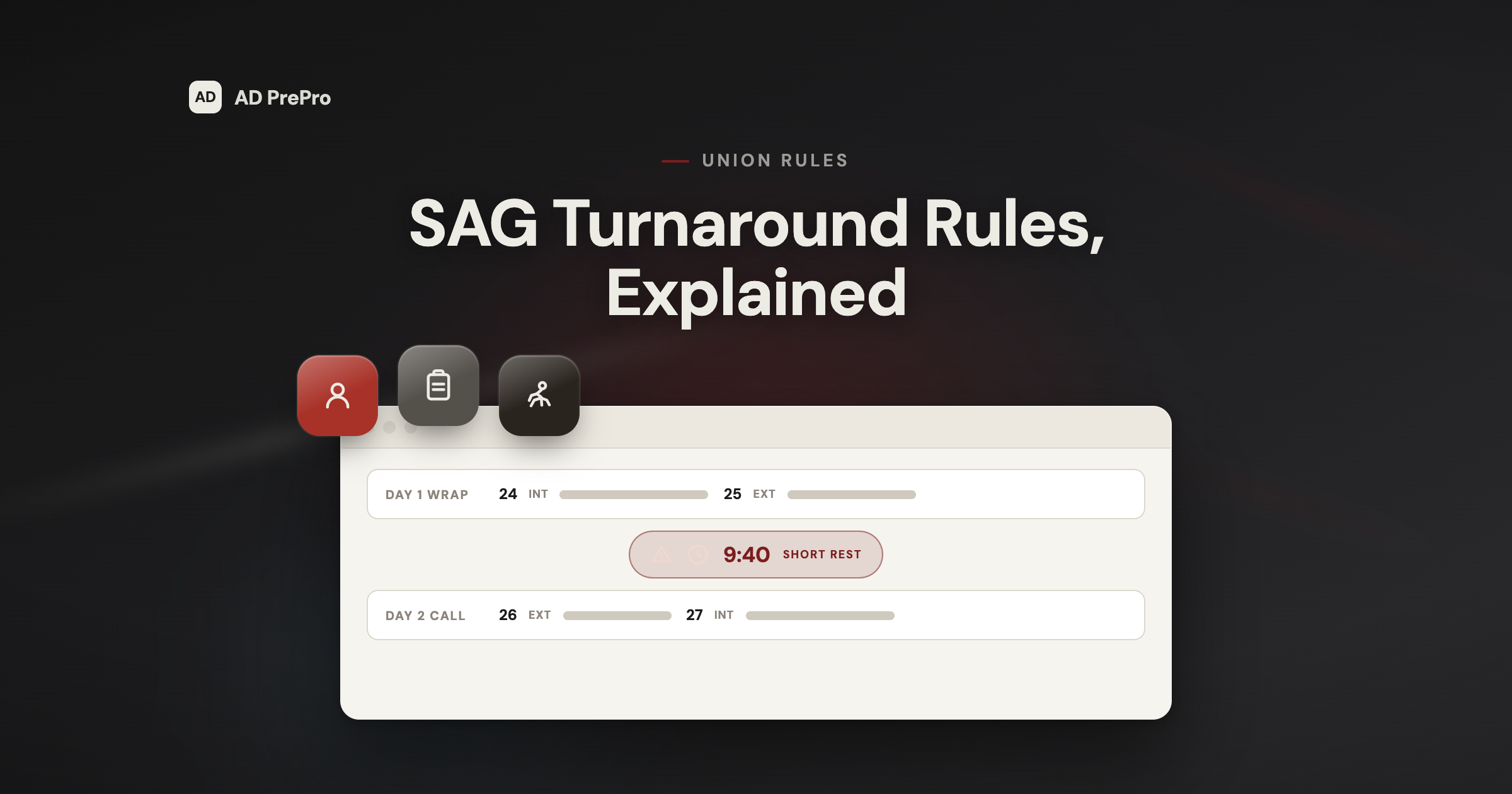
SAG Turnaround Rules Explained: The 12-Hour Rest Rule
Union & Compliance
One missed hour of rest is a forced call, and a forced call is real money. Here is the SAG turnaround math, plain, before it shows up on a cost report.
SAG turnaround sounds like one number: 12 hours. The problem is that the 12 hours isn't always 12, it's owed per performer instead of per company, and the version everyone remembers wrong is the one that actually costs money.
This guide covers the real SAG-AFTRA rest requirement, the two location exceptions that quietly change the math, the weekly rest rule almost nobody checks, what a forced call actually costs, and how to catch a short turnaround on the board instead of on the cost report.
What Turnaround Actually Means Under SAG-AFTRA
Turnaround is the rest a performer is owed between the moment they are actually dismissed and their first call the next day, for any purpose, including makeup, wardrobe, or hairdress. Not the scheduled wrap. The real one.
That distinction is where most short turnarounds hide. A day that was supposed to wrap at 9pm and actually wraps at 11:30 moves every performer's clock by two and a half hours, and nothing on the call sheet you printed that morning shows it.
The 12-Hour Rule, and the Two Times It Isn’t 12
In the studio zone, a SAG-AFTRA performer is entitled to 12 consecutive hours of rest from dismissal to next call. That is the default every schedule should assume until something on the day genuinely changes it.
The first exception: on location, for exterior photography, that 12 can drop to 10, but only once every four consecutive days, and only when the day before and the day after are also on that same reduced schedule. It is not a standing discount for every location day.
The second exception: on an overnight or distant location for a theatrical shoot, rest can drop from 12 to 11 hours on up to two non-consecutive days in a single workweek. Different trigger, different number, easy to mix up with the first one.
Reference · SAG-AFTRA Rest Thresholds
What You Actually Owe, and When
What a Forced Call Actually Costs
A violation of the daily rest period is a forced call, and it is owed per performer, per occurrence, not once per day for the whole call sheet. Two performers short on the same morning are two separate penalties.
| Performer type | Forced call penalty |
|---|---|
| Day performer | Their daily rate, or a fixed dollar cap, whichever is less, per violation |
| Weekly / 3-day performer | One day's pay, or a fixed dollar cap, whichever is less, per violation |
Weekly Rest: the One Everybody Forgets
Daily turnaround isn't the only rest a performer is owed. After a work week, SAG-AFTRA performers are entitled to one weekly rest period, 56 consecutive hours after a 5-day work week, 54 hours after a 6-day work week.
It gets missed because it doesn't live on any single day's call sheet. It only shows up when you look at the whole run of consecutive shoot days and check the gap before the next one against 56, not 12.
Minors Get Their Own Rule, No Matter the Contract
A minor performer's 12-hour turnaround isn't only a SAG-AFTRA term, it's California law. That means it applies even on a non-union production with a child actor, where nothing else in this post's contractual rest rules is in effect.
Treat a minor on your call sheet as a 12-hour floor by default, verify it against your production’s state before you assume otherwise, and check it first when you are triaging a tight morning.
How to Catch a Forced Call Before It’s a Forced Call
Every rule above is checkable in prep, using nothing but the schedule you already have and last night’s actual wrap. The order below is the order that catches the expensive mistake first.
Use the real wrap, not the scheduled one
A day that ran long moves every performer’s clock. Check turnaround against when people actually left, not when the call sheet said they would.
Check every performer, not the company
Turnaround is owed per person. Two performers released at different times off the same day can have two different rest gaps the next morning.
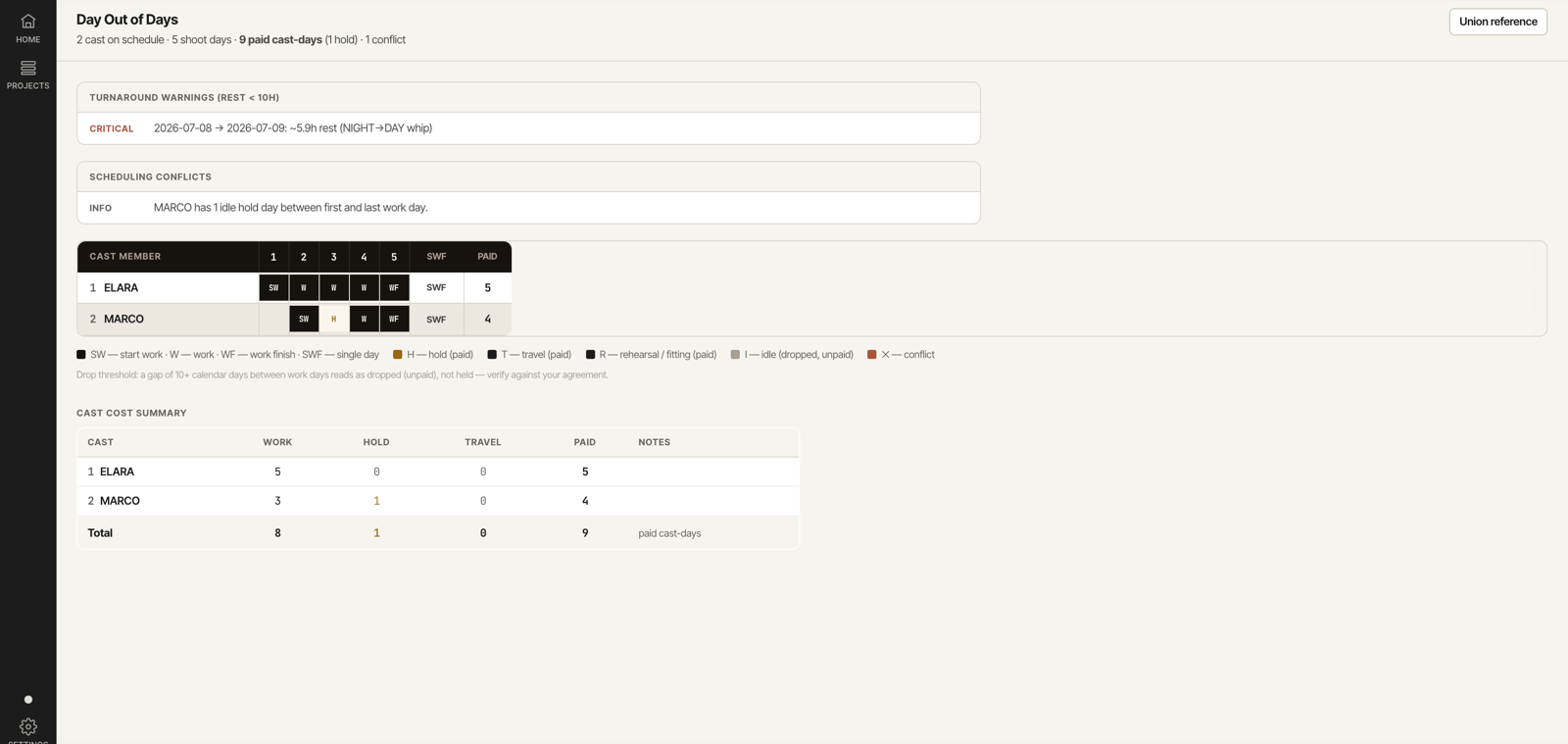
Flag the NIGHT-to-DAY swing first
A late-wrapping night scene followed by an early exterior call is where the 12-hour rule gets broken hardest. Check this pairing before anything else on the board.
Check minors against the 12-hour floor
Do this even on a non-union day. It is statute, and it does not care what your contract turnaround rule says.
Recheck weekly rest after any 5-plus day run
Daily turnaround can be clean all week and weekly rest can still be short. Check it separately once you know the run length.
None of this is exotic once you know what to check. The reason it slips is that it is five separate checks, per person, across a schedule that keeps moving until the day before the call sheet goes out.
Free Union Rules Quick Reference
The reference card above is the short version. Keep it next to your board while you schedule: the 12-hour default, both location exceptions and when they actually apply, the weekly rest numbers, and the minor floor, all in one place instead of five tabs.
SAG Turnaround Rules FAQ
Is SAG turnaround 12 hours for everyone? 12 hours is the studio zone default for SAG-AFTRA performers. It can drop to 10 or 11 hours under the specific location exceptions above, and a minor's 12-hour floor holds regardless of the contract.
What counts as the start of turnaround? The moment a performer is actually dismissed, not the scheduled wrap time. A day that runs long pushes every performer's rest clock later, even if the call sheet still says the old time.
Does a forced call apply per person or per day? Per person, per occurrence. If three performers are all short on the same morning, that is three separate violations, not one company-wide penalty.
Is IATSE turnaround the same as SAG-AFTRA? No. IATSE crew commonly work under a 10-hour turnaround, a different number for a different population, and it should never be assumed to match the cast rule on the same schedule.
Does a non-union production have to follow SAG turnaround? Only if it is written into the deal memo, except for minors, whose 12-hour rest is California law independent of the contract. Write the number down either way, because non-union has no automatic default.
Can software actually catch this before it happens? Yes, if it checks per performer against the real call and wrap times, across whichever profile the production is under. That is the difference between a flag you can act on in prep and a violation you find out about from a cost report.
Check It on the Board, Not on the Cost Report
You now have the actual thresholds: 12 hours by default, 10 or 11 under the two location exceptions, 56 or 54 for weekly rest, and 12 for a minor no matter what else is in effect. The math is simple. Checking it for every performer, every night, is the part that isn't.
AD PrePro checks turnaround per performer against your real call sheet times, across SAG-AFTRA, IATSE, and non-union profiles, and names exactly who is short before you send the next day's call sheet. It won't make the call for you. It just makes sure you're the one who catches it first.