How to Make Actor Sides: A 1st AD's Method + Free Template
Call Sheets
Sides look like a simple export: pull today's scenes, print, done. The part that actually keeps a set running is the manifest, the revision stamp, and knowing who gets which copy.
Sides sound like the easy part. Pull today's scenes out of the script, print them, hand them out. The problem is that a badly made side is worse than no side at all: an actor working from the wrong revision, a PA short one page, a confidential page loose in a parking lot.
This guide covers how to make actor sides the way a working AD actually builds them: which scenes to pull, the cover manifest that lets someone verify a packet is complete, the revision stamp, the formatting that keeps a page readable in a rush, and who gets a copy versus who doesn't. Plus a free template you can start from tonight.
What Sides Actually Are
Sides exist because nobody on set needs the whole script every day. An actor working scene 12 doesn't need scene 40, and handing it to them anyway means more pages to lose, more pages to leak, and more time flipping to find the right one.
The scenes come straight out of the shooting schedule: whatever is on the board for that day is what goes in the side, in the order the board has it, not the order the script does.
Picking the Right Scenes
Most sides are built one of two ways, and the difference matters for who is asking.
Pull a shoot day off the board
The normal case. Every scene scheduled for tomorrow, in shooting order, becomes one side. This is what goes out the night before a shoot day, same cadence as the call sheet.
Pull specific scenes for an audition or rehearsal
A director or casting director asks for particular pages, usually scenes that show off a character without needing the rest of the story explained. This is a quick-draft pull, not tied to a shoot day at all.
Check the revision before you pull anything
If the script changed since the last time these scenes were pulled, confirm you're building from the current draft. A side built off yesterday's pages is a side built wrong.
What Goes on a Sides Cover Page
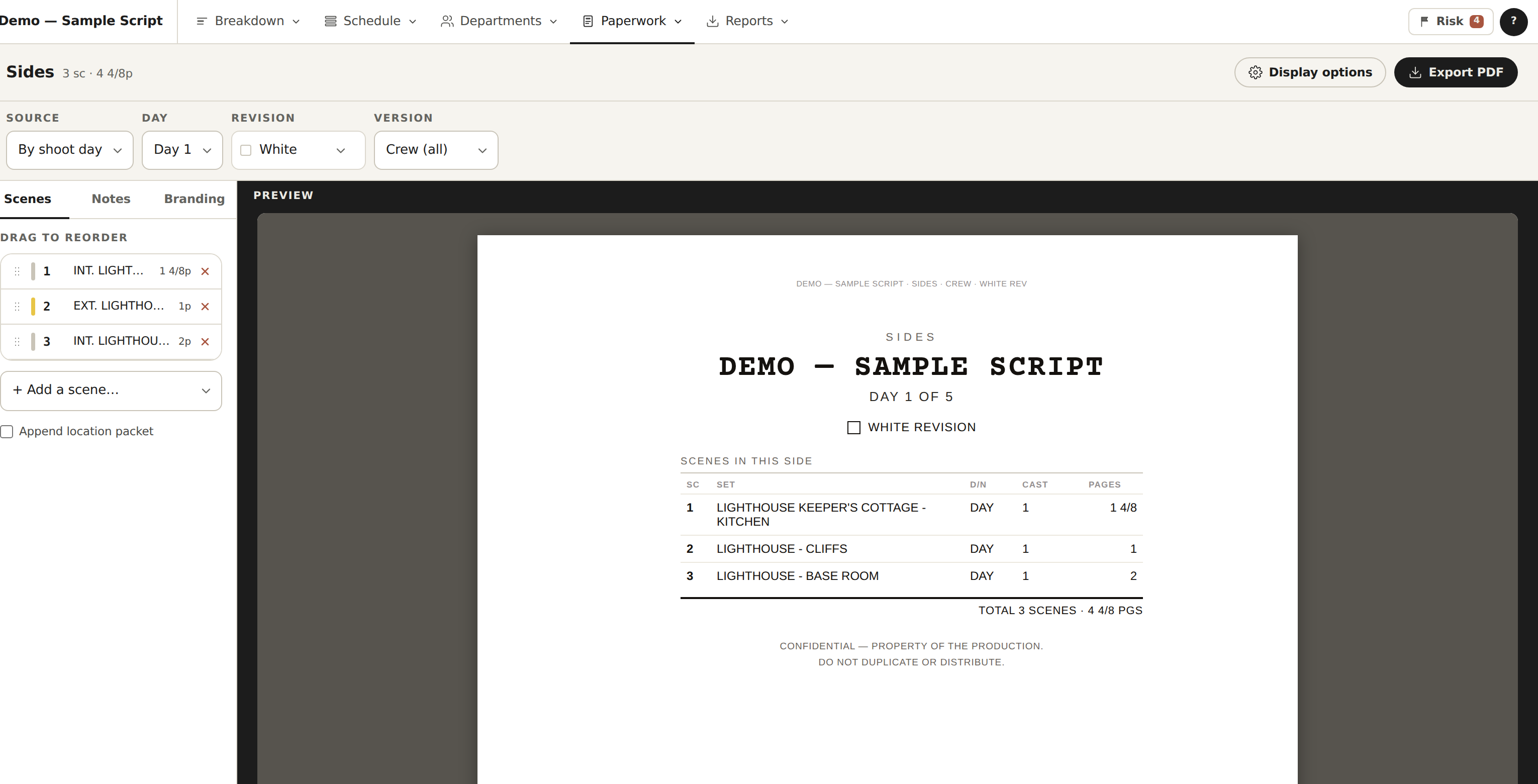
A stack of loose pages is not a professional side. A real sides packet opens with a cover page, and the cover page does one job: let anyone holding it confirm the packet is complete and current without reading a word of dialogue.
Reference · The Sides Cover Page
What the Cover Page Actually Does
The manifest is the part most homemade sides skip, and it's the part that saves the most time. A 2nd AD who can glance at a cover page and confirm five scenes, twelve pages, cast 1 and 3, doesn't have to flip through the whole packet to catch a missing page before it reaches set.
Revision Stamps: Sides Carry Them Too
Script pages get revision colors when they change: white for the original draft, then blue, pink, yellow, and onward through a fixed order. Sides inherit whichever color the pages they contain are currently on.
This is not the same revision system as the call sheet's Rev A, B, C. Those track changes to tomorrow's call sheet and reset every shoot day. The script's revision colors track changes to the screenplay itself and never reset for the life of the show. A side stamped with the wrong color is a side built from the wrong draft.
Formatting Rules That Keep a Side Readable
Sides get carried in a back pocket, marked up in pencil, and read in bad light between setups. The formatting exists to survive that, not to look nice on a screen.
- True screenplay format. Same margins, same character-cue and dialogue tab stops as the shooting script. An actor who has memorized a line by its position on the page needs that position to hold.
- A scene header strip. Scene number, INT or EXT, set, day or night, and the cast in it, printed above the scene so nobody has to guess what they're looking at mid-flip.
- Continuity markers on long scenes. (MORE) at the bottom of a page that keeps going, (CONTINUED) at the top of the next one, and the scene number repeated. Standard screenplay convention, and sides need it as much as the full script does.
- The scene number flush in both margins. Old habit, still useful: it lets someone find scene 12 by riffling the edge of the stack instead of reading headers.
- A running identifier on every page. Something small in the margin naming the production, the revision, and whether this copy is talent or crew, so a page found on the floor can be traced back.
Who Gets a Copy, and the Confidentiality Mark
Not everyone gets the same side. Cast usually only sees their own scenes and the safety notes that apply to them. Crew sides can carry the full day's production notes: camera setups, art department instructions, anything the floor needs that a performer doesn't.
Both versions need a confidentiality mark. A diagonal watermark across the page, a footer line reading something close to "confidential, do not duplicate or distribute," or both. Scripts leak from loose pages more often than from anything more sophisticated, and a side is the loosest page on set.
Mistakes That Make Sides Useless
Five mistakes account for most of the sides complaints on any set. None of them are exotic.
- Pulling from the wrong draft. The single most common failure, and the one the revision stamp exists to prevent.
- No cover manifest. Without it, the only way to confirm a packet is complete is to read the whole thing, which nobody does under a call time.
- Full-size pages. Sides are meant to be carried all day. A stack of full letter-size pages doesn't fit a back pocket and doesn't survive a rewrite in the rain.
- Crew and talent sides mixed up. A crew side with a cast member's home contact info in the department notes, handed to the wrong person, is not a hypothetical.
- Sent too late. Sides go out on the same clock as the call sheet, the night before. An actor who gets pages at 6am has had no time to prepare.
Run these three checks before a sides packet leaves the office, every time.
- Every scene matches the current revision color
- The cover manifest lists every scene, and the page count adds up
- Talent and crew versions carry the right notes, and both carry a confidentiality mark
Free Sides Template
If you're building sides by hand, start from a real one instead of a blank page. Our free sides template lays out the cover manifest, the revision stamp, and the scene header strip in the standard order, sized to print half-page so it fits a back pocket.
It's the same structure the software builds for you automatically, so nothing about how you think through a side has to change if you move from a template to a tool later.
Actor Sides FAQ
What are sides in film production? Sides are the pages of a script covering only the scenes shooting on a given day, or the scenes a director wants for an audition or rehearsal. They are a subset of the full script, formatted to be carried and marked up on set.
How many pages should a side be? As many as the day's schedule requires, no more. Sides are usually printed half-page size to keep a full day's packet compact enough to carry, not trimmed to a fixed page count.
Who prepares sides on a film set? Usually the 2nd AD or a production assistant, working from the shooting schedule the 1st AD owns. On a small crew, the same person building the call sheet often builds the sides.
What's the difference between sides and a full script? A full script is every scene in the story, in story order. Sides are only the scenes shooting on one specific day, in shooting order, with a cover manifest and revision stamp the full script doesn't carry.
Do sides need a revision stamp? Yes. Sides carry the same revision color as the script pages they're pulled from, so anyone holding a side can tell at a glance whether they're working from the current draft.
Can sides be generated automatically? Yes, if a tool already has your schedule and breakdown, it can pull the right scenes, build the cover manifest, and stamp the revision for you. Review the packet before it goes out. A missing page is not something you want discovered on set.
Build the Packet Once, Trust It All Day
You now have the whole method: which scenes to pull, the cover manifest that proves a packet is complete, the revision stamp, the formatting that survives a back pocket, and who gets which version.
AD PrePro builds sides from the schedule and breakdown you already have in the app: pick the day or the scenes, and the cover manifest, revision stamp, and confidentiality mark come with it. Select a shoot day and the first side is already most of the way built.