What Does a 1st AD Do? The Real Answer (Free Film School Edition)
The AD Role
The official answer leaves out 90% of the job. Here is the full one: breakdown, stripboard, DOOD, the language of the set, and the part no job description mentions.
The official answer is: "The 1st AD manages the shooting schedule and runs the set."
Which is true the way "the pilot flies the plane" is true. Technically accurate. Wildly insufficient.
I couldn't help but wonder: if the director is the creative vision and the producer is the money, then who is the person holding the whole machine together? That's the 1st AD. And whoever decided to put the word "assistant" in that title has a lot to answer for.
The 1st AD takes a 120-page screenplay and translates it into something 50 to 200 people can execute simultaneously, on a deadline, on a budget, with the weather working against them. Part project manager, part logistics engineer, part diplomat, part therapist. The only person on a production whose job touches every single department, every single day, in prep and on set.
This is the full answer.
What a 1st AD Actually Is
Let's start with the title problem. In most industries, an "assistant" is someone who supports a senior person. That is not what a 1st Assistant Director is. The 1st AD doesn't assist the director in a creative sense. They run the set so that the director can be fully creative without drowning in logistics.
Think of it this way: the director is responsible for what gets captured. The 1st AD is responsible for whether it gets captured: on time, on schedule, within the day's constraints.
The clearest distinction: if a DP has a lighting question, they go to the director. If a DP has a scheduling question, they go to the 1st AD. And if the director and the DP are deep in a creative conversation while the clock is burning, and someone needs to step in and say "we have 20 minutes and three setups left," that's the 1st AD too.
The 1st AD is the operational center of the production. They hold the plan, absorb pressure from above (producers, studio, financiers), and protect the crew working below.
Pre-Production: Where the Real Work Starts
Here's the misconception: most people picture the 1st AD standing at the edge of the set, megaphone in hand, yelling "quiet on set!" That's the visible tip. The real job, and where productions are won or lost, happens in the weeks before Day 1.
While the director is in tone meetings and the DP is doing tech scouts, the 1st AD is reading the script with a completely different part of their brain. Not "what does this scene mean?" but "what does this scene cost in time, people, and logistics?"
Reference · The AD's Prep Documents
What a 1st AD builds in prep
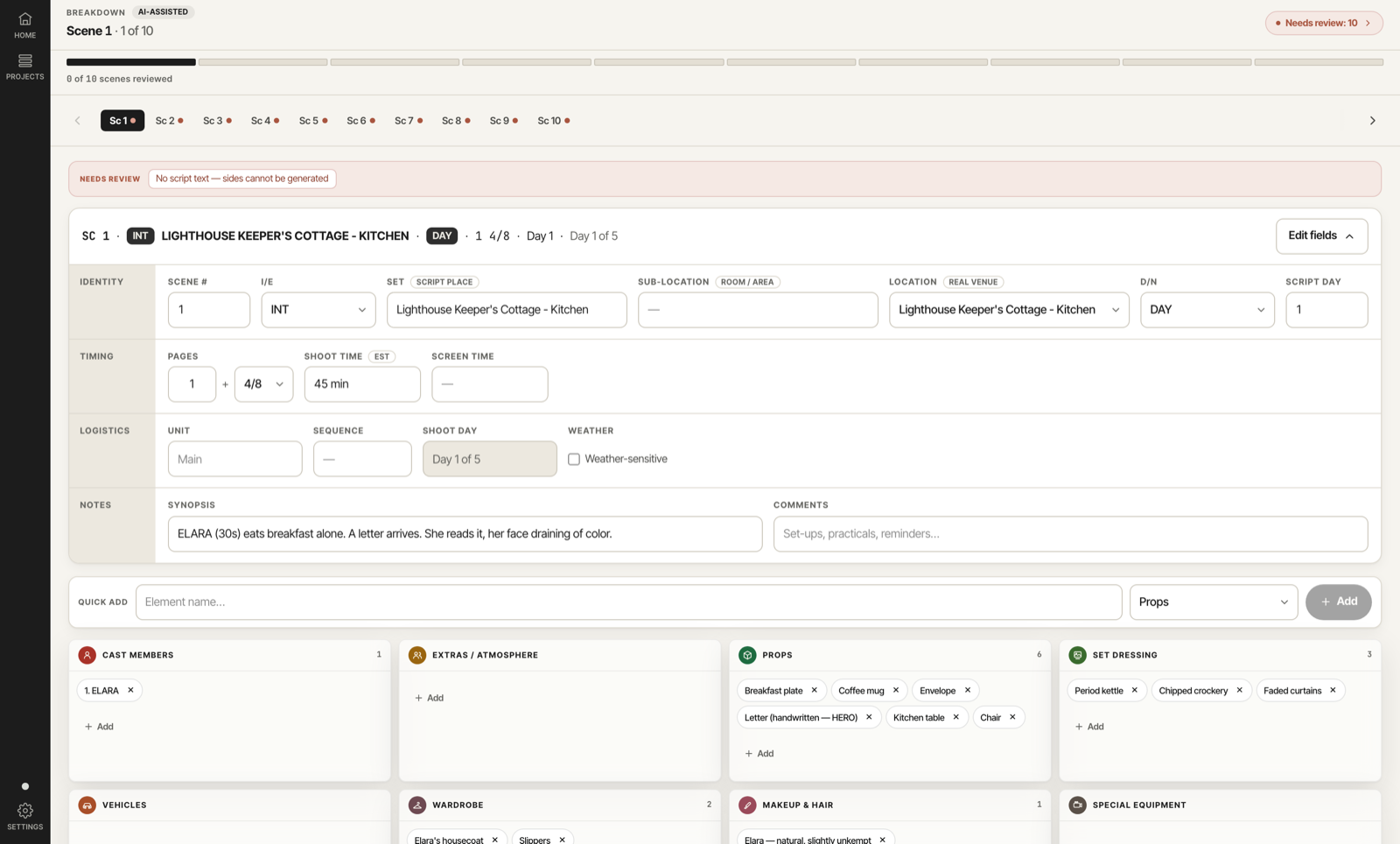
Script Breakdown
The script breakdown is the foundation of everything else. The 1st AD goes through every scene and catalogues what it physically requires: not the themes or the subtext, the actual nuts and bolts.
In each scene, they're looking for:
- Cast: which characters are present (and therefore which actors need to be booked and paid)
- Location: interior or exterior, and where
- Time of day: day, dusk, night, dawn (this matters enormously when you're grouping scenes)
- Pages: a rough indicator of how long the scene will take to shoot
- Extras/Background Actors: how many, doing what
- Props: anything an actor handles that has to be sourced, made, or cleared
- Special effects: practical fire, rain, breakaway glass, anything requiring a safety officer on set
- Stunts: anything needing a stunt coordinator and dedicated prep time
- Vehicles: cars, horses, motorcycles, anything that needs wrangling and insurance
- Wardrobe/Hair/Makeup: anything special that will add time at the top of the day
- VFX/Greenscreen: anything requiring markers, witness cameras, or post-production handoff
Every element gets tagged. Every scene becomes a breakdown sheet. Those sheets become the raw material for everything the 1st AD builds next.
The Shooting Schedule
From the breakdown, the 1st AD builds the shooting schedule: the order in which scenes will be filmed across the entire production. This is not the same as the order they appear in the script. The shooting order is organized around efficiency, not narrative.
Key factors the 1st AD weighs:
Location grouping: shooting all scenes at a given location together, so you don't pay to come back.
Cast availability: if your lead is only available for the first two weeks, those scenes go first. If a supporting actor flies in for three days, their scenes need to be locked around that window.
Interior vs. exterior: exterior scenes are vulnerable to weather. Many schedules load the most critical exteriors early, with interior "cover sets" standing by in case the sky doesn't cooperate.
Turnaround: union agreements require minimum rest time between wrap and the next call time (typically 12 hours for crew). A night shoot followed by an early morning call creates a "forced call," a turnaround violation that triggers penalty payments. The 1st AD's schedule is designed to avoid these.
Scene complexity: heavy days go earlier in the shoot, when the crew is fresh and the momentum is high.
The schedule will change. It always does. But a well-built schedule means you're adapting from a strong foundation rather than patching a broken one.
The Stripboard
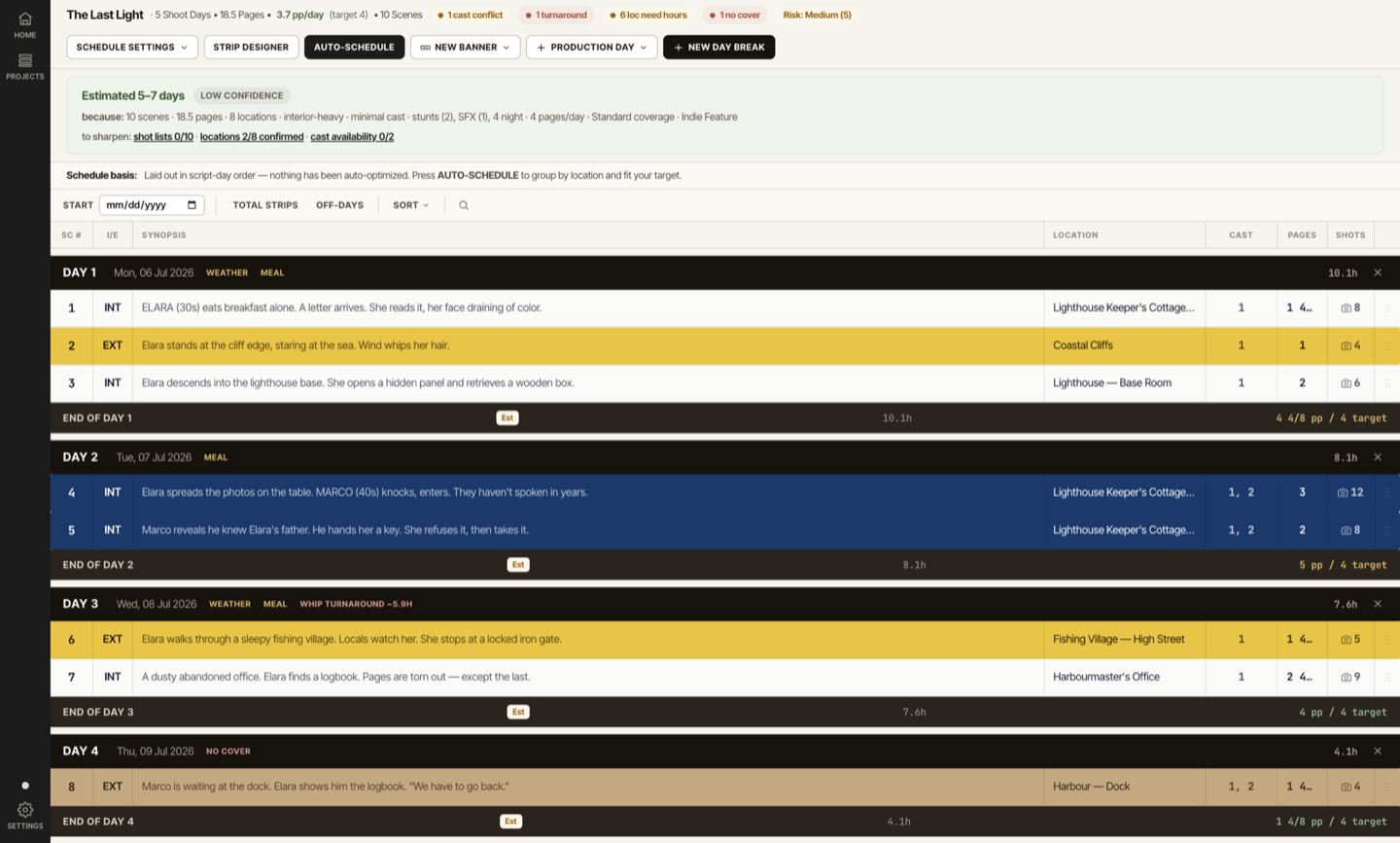
The physical (or digital) representation of the shooting schedule is the stripboard. Each scene gets a strip showing its scene number, location, cast members, page count, and whether it's INT or EXT, DAY or NIGHT. Those strips get arranged into shoot days, separated by day breaks.
The 1st AD rearranges those strips constantly during prep. Moving one scene means evaluating its ripple effect: does this create a cast conflict? A forced call? Does it break location grouping? Does it make Day 4 a 14-hour day? On a well-run prep, the 1st AD has worked through all of these scenarios before production begins.
Traditionally this was a physical board with card strips in a frame. Today, most productions use digital scheduling software, where you can drag strips, flag violations automatically, and send an updated schedule to the whole crew in minutes.
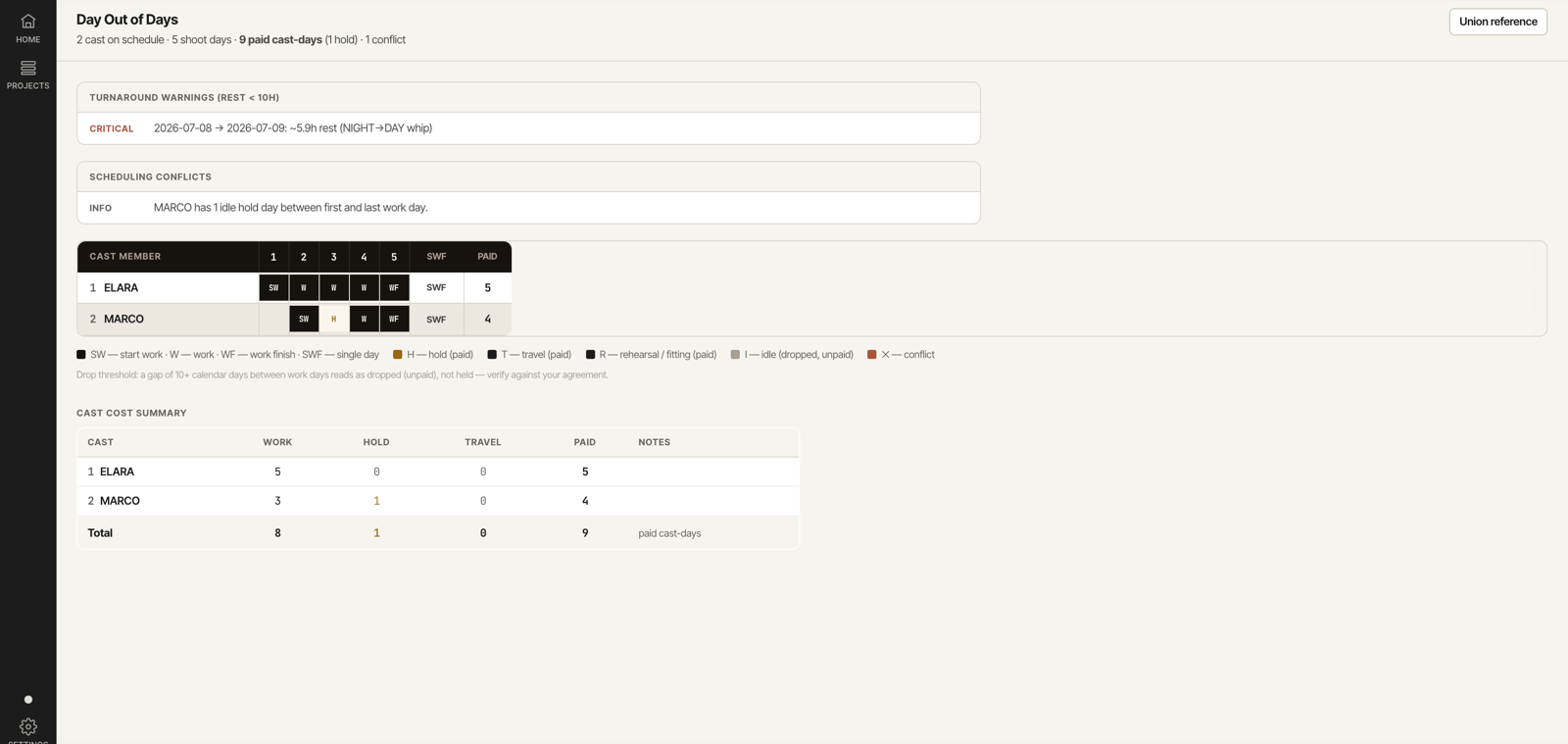
The Day Out of Days (DOOD)
Once the schedule exists, the 1st AD produces a Day Out of Days, a grid that maps every cast member against every shoot day.
| Code | Meaning |
|---|---|
| SW | Start/Work, first day on the production |
| W | Work, shooting on this day |
| WF | Work/Finish, last day on the production |
| H | Hold, on hold (paid, available, not shooting) |
| T | Travel, travel day |
| SWF | Start/Work/Finish, one-day appearance |
The DOOD answers the question every producer asks within 48 hours: "How many days is she in it?" It also surfaces conflicts before they become expensive problems on set. If an actor's deal is for 15 days and the DOOD shows 18, that conversation happens now, not on Day 16.
Scouts and Prep Meetings
The 1st AD doesn't just build documents during prep. They're in the field and in the room.
They walk every location with the director and DP: thinking about sun position at different times of day, parking for equipment trucks, where basecamp sets up, how long it will realistically take to move between setups. They're translating a creative vision into a timeline before a single frame is shot.
They sit in department meetings, talking to the production designer about build times, to the costume designer about fitting schedules, to the stunt coordinator about rehearsal days. These conversations surface the problems the schedule hasn't accounted for yet. Better to find them here.
By the time Day 1 arrives, a well-prepped 1st AD has already solved most of the problems they would otherwise be solving at 6am under live pressure. That's not luck. That's the prep.
Production: What Running the Set Actually Means
On the day of shooting, the 1st AD has one job: keep the production moving toward the day's goal. Every minute the camera isn't rolling is a minute that costs money and gets you further behind.
The Language of the Set
One of the most immediately practical things to understand about the 1st AD's role is the vocabulary they use to run the set. These calls keep 50+ people coordinated without constant confusion.
"Picture's up": we're about to roll. Everyone needs to be quiet and in position.
"Last looks": the final window for hair, makeup, and wardrobe to make adjustments before the shot. After this, nothing changes.
"Lock it up": secure the perimeter. No movement, no noise, nothing that would interrupt a take.
"Roll sound": the sound department starts recording. They respond with "speed" when they're running at correct levels.
"Camera": the camera department starts rolling.
"Action": the director begins the scene. (On large-scale set pieces, the 1st AD may call this on the director's behalf, but it's always the director's call.)
"Cut": the director stops the take.
"Moving on": we've finished this scene or setup and are moving to the next one.
"Lunch is up": meal break called. On union sets, a meal must be provided within 6 hours of crew call, or the production pays a penalty for every 30-minute increment after. The 1st AD tracks this clock constantly.
"That's a wrap on [name/location/scene]": we're done with that element.
You'll absorb this vocabulary fast. What takes longer is learning when to say it. That's where experience comes in.
First Team vs. Second Team
"First team" is the principal cast, the actors. "Second team" (or stand-ins) are people who stand in for actors during camera and lighting setup, so the actual talent isn't standing under hot lights for 45 minutes while the DP works.
When setup is ready, the 1st AD calls "bring in first team": stand-ins leave, actors come in, and shooting begins.
Managing this transition efficiently is one of the most tangible ways a 1st AD saves time on set. Actors waiting on set when they're not needed wastes their time and focus. Actors not ready when the set is? That wastes everyone else's.
Managing the Clock
The 1st AD is tracking multiple timelines simultaneously at all times:
The shoot day: call time, scheduled wrap, and how many setups are still left. If you're behind, you need to know that early, not at 6pm when everyone's exhausted.
The meal clock: time since last crew meal. Missing the union window means penalties, every 30 minutes, for every crew member on the call sheet.
Turnaround: how many hours until the next day's call. If wrap runs late, the following morning's call may need to move.
Actor finish times: hard contractual outs, minor's regulated hours, international travel departures. These are immovable. The schedule bends around them.
When a day goes sideways (a setup takes twice as long as planned, the weather shuts down the exterior, an actor is late), the 1st AD makes the call on what moves, what compresses, and what gets pushed. This requires having already worked through contingencies during prep. The ADs who look calm under pressure aren't calm because nothing is going wrong. They're calm because they've already thought about this.
Protecting the Director's Focus
The director on a film set is surrounded by people who need something from them every few minutes. The 1st AD is the filter. They handle what can be handled, defer what can wait, and only surface what genuinely requires the director's attention right now.
This isn't just an organizational courtesy. It's creative protection. A director who isn't fielding scheduling questions, department conflicts, and producer check-ins can stay in the scene, stay with the actors, and make better work. That's the point.
The 1st AD vs. The 2nd AD
On productions beyond a certain size, the 1st AD works alongside a 2nd AD.
The 1st AD lives on set, with the camera. They're calling the shot, tracking the schedule, managing the real-time relationship between the director and crew.
The 2nd AD manages everything flowing through the set from the outside. That includes actor paperwork and contracts, call sheet preparation, basecamp coordination (making sure the right actor is in the right trailer at the right time), extras management, and communication between the set and the production office.
The cleanest split: the 1st AD manages the set and the schedule. The 2nd AD manages the people and the paperwork.
On larger productions there's also a 2nd 2nd AD (Additional 2nd AD), who supports the 2nd with extras, paperwork, and logistics overflow. On small productions, the 1st AD does all of it. This is, incidentally, a great way to learn fast.
The Part Nobody Teaches You
Here's what the job description will never say, and what actually separates a good AD from one crews ask back for.
Knowing when to push and when to give it a moment. A director chasing a take isn't always wrong. Sometimes that fifth take is the one that makes it into the film. The 1st AD has to read the situation (is this productive searching or expensive indecision?) and find the right moment to say something. Too early and you've broken the director's focus. Too late and you've lost the day.
Delivering bad news without tanking the energy. At some point on every production, you'll need to tell a department head their scene got cut. You'll need to tell the director the day's schedule isn't going to work. You'll need to tell the producer you're going to miss wrap by two hours. The information matters less than how you deliver it. "We're behind, here's the plan" lands very differently than "we're behind." Learn the difference.
Managing up. Producers and line producers watch the 1st AD's decisions closely. When a judgment call costs money, you need to be able to explain it. When a producer pushes you to go faster in a way that would compromise safety, and it will happen, you push back. Professionally, clearly, without apology.
Reading your talent. Actors bring everything to set: confidence, anxiety, history, ego, generosity. Building trust with your lead early pays dividends for the entire shoot. Learn what they need to feel ready. Some actors need quiet before a take. Some need to keep moving. Some need you to talk through the logistics with them; others need you to keep the machinery invisible. You won't know until you ask.
Absorbing pressure without passing it down. The 1st AD sits between the producers above and the crew below. On hard days, and there are always hard days, the pressure flows down from above. Your job is to stop it there. The grip who's been on their feet for ten hours doesn't need to feel the budget meeting happening two floors up. The PA on their first job doesn't need to carry the weight of a delayed schedule. You take it. That's the role. And when the day wraps and people are packing out, you make sure they leave feeling like the work was worth it.
Set culture flows from the 1st AD more than almost anyone else on the production. The people who understand this are the ones crews talk about for years.
How to Become a 1st AD
No film school degree makes you a 1st AD. The path is worked, not studied.
The typical progression runs bottom to top, and every rung teaches the one above it:
Production Assistant (PA)
The entry point. PAs do everything: running errands, locking up locations, moving gear, making coffee. The ones who end up becoming ADs start paying attention early. They watch how the set is called, they notice what the 2nd AD is managing, and they volunteer for the things that aren't glamorous.
2nd 2nd AD (Additional 2nd AD)
In DGA productions, this is the first official AD title. You're managing extras, running paperwork, supporting the 2nd AD. Mostly you're learning by watching.
2nd AD
Now you're building call sheets, wrangling cast, running basecamp. You start to see the full shape of the production because you're managing the pieces that move through it.
1st AD
You know the job because you've done every version of the job below it.
The DGA (Directors Guild of America) has a formal apprenticeship program with specific hour requirements at each tier before you can advance. Non-union productions have a more informal path, but the experience curve is the same.
What accelerates the timeline: work on complex productions. A short film with a night shoot, three locations, a stunt, and a cast of six teaches you more than ten productions shot in one room. Seek difficulty. That's where the real training is.
The "Assistant" Is a Lie
The title is a historical artifact. In the early studio era, the 1st AD genuinely did assist the director: creative input, direct collaboration, close personal support. The role evolved. The title stayed.
Today the 1st AD is the person who makes the day possible so the director can focus on directing. That isn't assistance. That's operational leadership. Control over the schedule, over the crew's time, over the one resource every production is always running out of: the shooting day.
Every great film you've ever seen had a 1st AD who was either extraordinary or good enough. You can usually tell the difference, not by watching the film, but by talking to anyone who worked on it.
Start With the Right Tools
Every smooth set day is the result of prep work done weeks earlier. A well-built breakdown and schedule means the 1st AD has already solved most of the problems they'd otherwise be solving under pressure: cast conflicts, turnaround violations, company move timing, cover sets for bad weather.
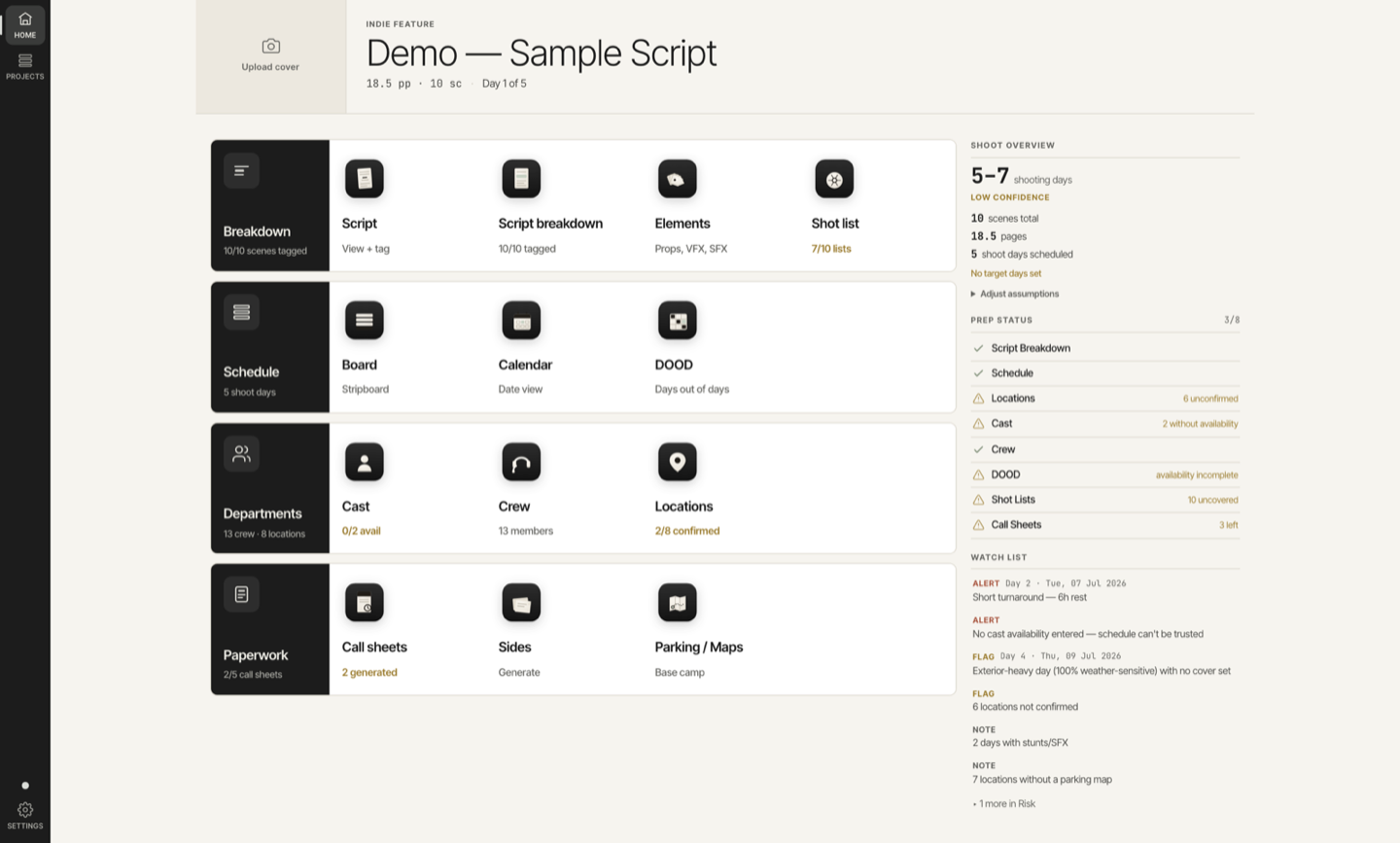
AD PrePro handles script breakdown, scheduling, Day Out of Days, call sheets, and sides. The full pre-production stack, in one place. Upload your script and start building.