Scheduling Minors on Set: A 1st AD's Method for Capped Hours
Union & Compliance
The law caps a minor's hours. It does not tell you that the number changes by age band and by which school regime applies today. Here's the version a 1st AD actually needs.
Scheduling minors on set means building the day around a cap the law sets, not one you'd prefer to build around. The problem is that the cap is not one number. It moves with the child's age, and it moves again depending on whether a studio teacher delivered their schooling on set today or they came from their own regular school that morning.
This post covers the two separate clocks a minor's day runs against, the age-banded caps for each, which school regime applies on a given day, the turnaround rule that survives even a non-union deal, and the standing requirements (guardian, tutoring) every minor day carries. Plus a reference chart worth keeping next to your board.
The Two Clocks: At-Site Hours vs. Work Hours
Most people reduce a minor's day to a single number, like 'nine and a half hours.' That number exists, but it is a flat outer limit. Underneath it are two separate, age-banded clocks that both have to clear before you can call the day legal.
Reference · Minor On-Set Clocks
The Two Clocks You Are Actually Capping
The at-site clock is the one that decides when the minor has to leave, full stop. The work-hours clock is the one that decides how much of that time can actually be spent shooting them. A day can be legal on one clock and already over on the other.
The Age Bands, in Full
Both caps are age-banded. The standard reference for SAG productions is California Title 8 §11760, and the bands step down hard at the youngest ages, which is exactly where a schedule built by feel gets it wrong.
| Age band | At-site cap | Work cap · studio teacher on set | Work cap · no school that day |
|---|---|---|---|
| 15 days – 6 months | 2h | 20 min | 20 min |
| 6 months – 2 years | 4h | 2h | 2h |
| 2 – 6 years | 6h | 3h | 3h |
| 6 – 9 years | 8h | 4h | 6h |
| 9 – 16 years | 9h | 5h | 7h |
| 16 – 18 years | 10h | 6h | 8h |
Notice the jump between the youngest three bands and the oldest three. Under age six, the work cap does not change based on schooling at all, because a child that young has no school-day regime to distinguish. From age six on, it splits into two different numbers, and picking the wrong one is the single most common way a minor's day quietly runs long.
Own School vs. Studio Teacher: Which Regime Applies
A studio teacher on set is the regime most people picture, and it is the more generous one: the work cap in the middle column above. The stricter regime is the one people forget to check, because it looks like good news. The minor already got their schooling before they even arrived.
That is exactly why it is stricter. A minor who attended their own school that day and then comes to set is capped further, at the at-site cap minus six hours. For the 6-to-9 band that is 2 hours. For 9-to-16, it is 3. For 16-to-18, it is 4. Treat that day like a normal work-cap day and the schedule is over before anyone notices.
Turnaround Is Law Here, Not Just a Union Term
A minor is owed a 12-hour turnaround between the end of one workday and the start of the next. On a SAG-AFTRA production that reads like a standard turnaround rule. It is not only that.
For a minor, the 12-hour rest period is California statute, independent of any union agreement. That means it holds on a non-union indie with no turnaround clause written into anyone's deal memo. There is no contractual off-ramp for a minor's rest the way there can be for an adult performer on a non-union call.
A minor's turnaround is not a term you negotiated. It is a floor the production does not get to schedule around.
Building the Call Sheet Around the Window
Every production with a minor on the call sheet should also have a written work window on file: the earliest call and the latest wrap that production agreed to for that performer, inside the statutory caps. That window, not the caps themselves, is what actually drives the day-to-day call sheet.
Set the age band the day the minor is cast
Do not estimate from memory on the morning of the shoot. The band decides both clocks, and guessing wrong on set is how a legal day turns into a violation nobody meant to create.
Confirm the school regime for each specific day
Own-school days and studio-teacher days can both appear across one schedule for the same performer. Check it per day, not once for the whole show.
Lock the agreed work window in writing before the board goes out
The window belongs on the cast record, not just in an email thread. It is what the call sheet generator should clamp the minor's call and wrap to, every day, automatically.
Order the day so the minor's pages land inside the window
A minor with a 9-to-5 window cannot be the reason a 7 a.m. company move gets scheduled. Sequence their scenes to the part of the day their window actually covers.
Check the 12-hour turnaround like a statute, every day, non-union included
Do not reserve the turnaround check for union productions. A minor's rest period does not care what kind of production is shooting them.
- Age band identified and on the cast record, not estimated on the day
- School regime confirmed for today specifically (own school vs. studio teacher)
- At-site cap and work-hour cap both set, as two separate numbers
- Agreed work window on file and reflected on the call sheet
- Guardian booked and listed
- Studio teacher booked, if today is a tutored-on-set day
- 12-hour turnaround confirmed from the minor's actual wrap time, not the crew's
Guardian and Tutoring: The Standing Requirements
Two requirements apply on every single day a minor works, regardless of age band or school regime, and they are easy to treat as one-time setup instead of a standing line item.
- A guardian on set, in sight and sound of the minor, on every work day the minor is called.
- Tutoring or schooling hours, delivered by a studio teacher on any weekday work day the minor would otherwise be in school.
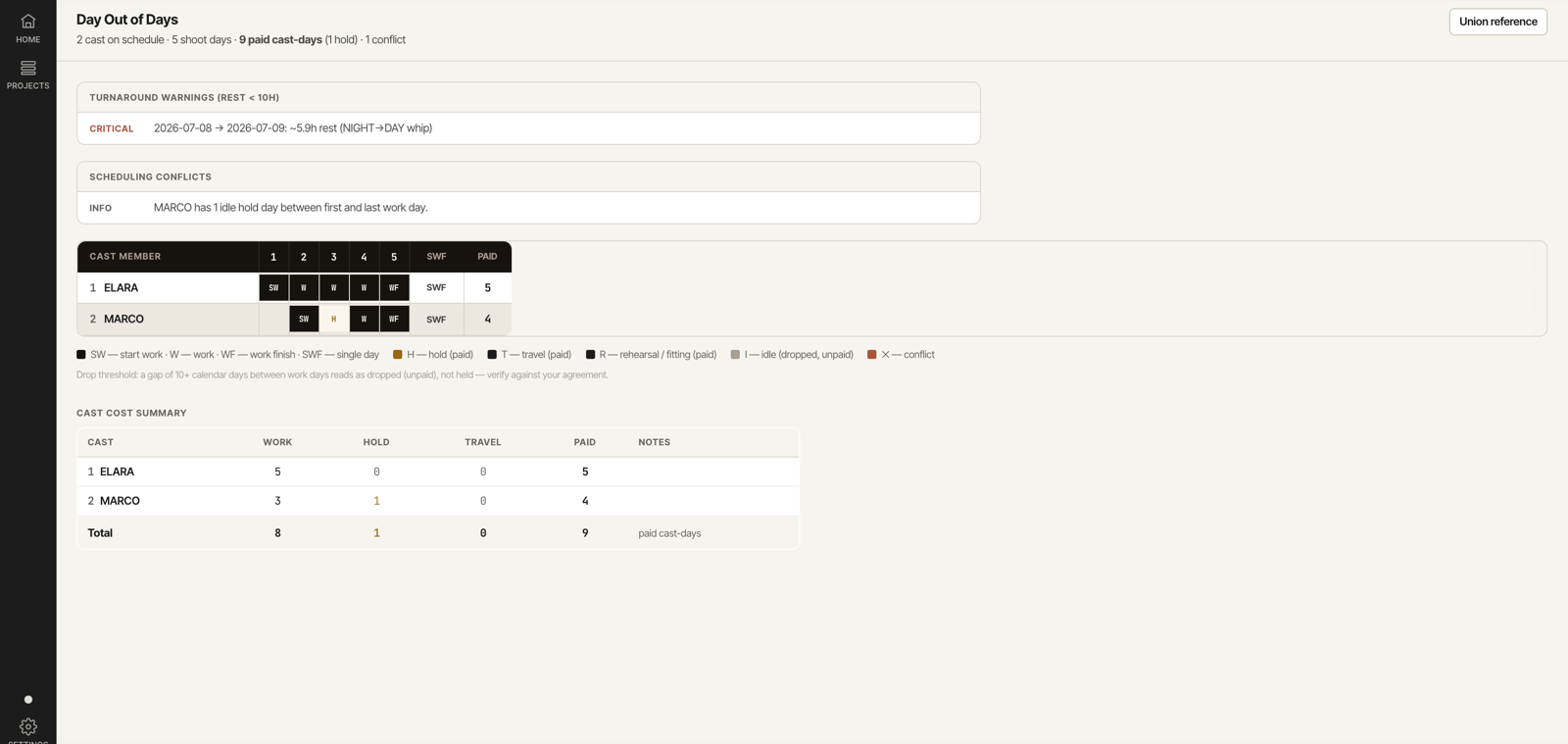
Neither of these is a flag that clears once you have handled it. A guardian confirmed for day one of a three-week shoot is not confirmed for day fourteen. Track both as a requirement that renews every work day, the same way you would track a DOOD status instead of a one-time checkbox.
Free Minor Scheduling Reference
The table and the two-clocks card above are the version worth keeping next to your board: both caps, both school regimes, in one place instead of reconstructed from a labor code section and a producer's memory of the last minor they scheduled.
Pair it with the work window you keep on the call sheet for that performer. The window is what the day actually gets built around; the age band and school regime are what set the window in the first place.
Scheduling Minors on Set: FAQ
What are the age bands for minor on-set hours? The standard California reference (Title 8 §11760) steps down from a 2-hour at-site cap for infants under 6 months to a 10-hour at-site cap for 16-to-18-year-olds, with the work-hour cap always lower and split further by school regime for ages 6 and up.
What is the difference between at-site hours and work hours for a minor? At-site hours count everything, work, meals, rest, and on-set schooling, from arrival to departure. Work hours count only on-camera time, so the work-hour number is always smaller than the at-site number for the same day.
Does a minor still need a 12-hour turnaround on a non-union production? Yes. A minor's 12-hour rest period is California statute, not only a SAG-AFTRA term, so it applies even when nothing else about the production's turnaround is contractual.
What changes when a minor attends their own school instead of being tutored on set? The work-hour cap drops to the at-site cap minus six hours, which is stricter than the studio-teacher regime for the same age band. It is the school day people most often forget to check.
Is a guardian required for every minor on set? Yes, on every work day, in sight and sound of the minor. It is a standing requirement, not a one-time confirmation at the start of the shoot.
Can software actually catch a minor-hours violation before it happens? Yes, if it tracks the age band, the school regime, and the agreed work window per day as the schedule is built, and flags a day that would exceed either clock before the call sheet goes out rather than after the day already happened.
Two Clocks, One Schedule
You now have the actual mechanics: two clocks instead of one flat number, six age bands, a stricter regime on own-school days, and a 12-hour turnaround that holds whether or not the rest of the production is union. None of it is exotic. It is just five separate facts that have to be checked together, per minor, per day.
AD PrePro tracks a minor's age band, work window, and standing guardian and tutoring requirements against every shoot day, and clamps their call sheet time to the window your production agreed to. It will not decide the schedule for you. It makes sure the cap is checked before the day, not after.