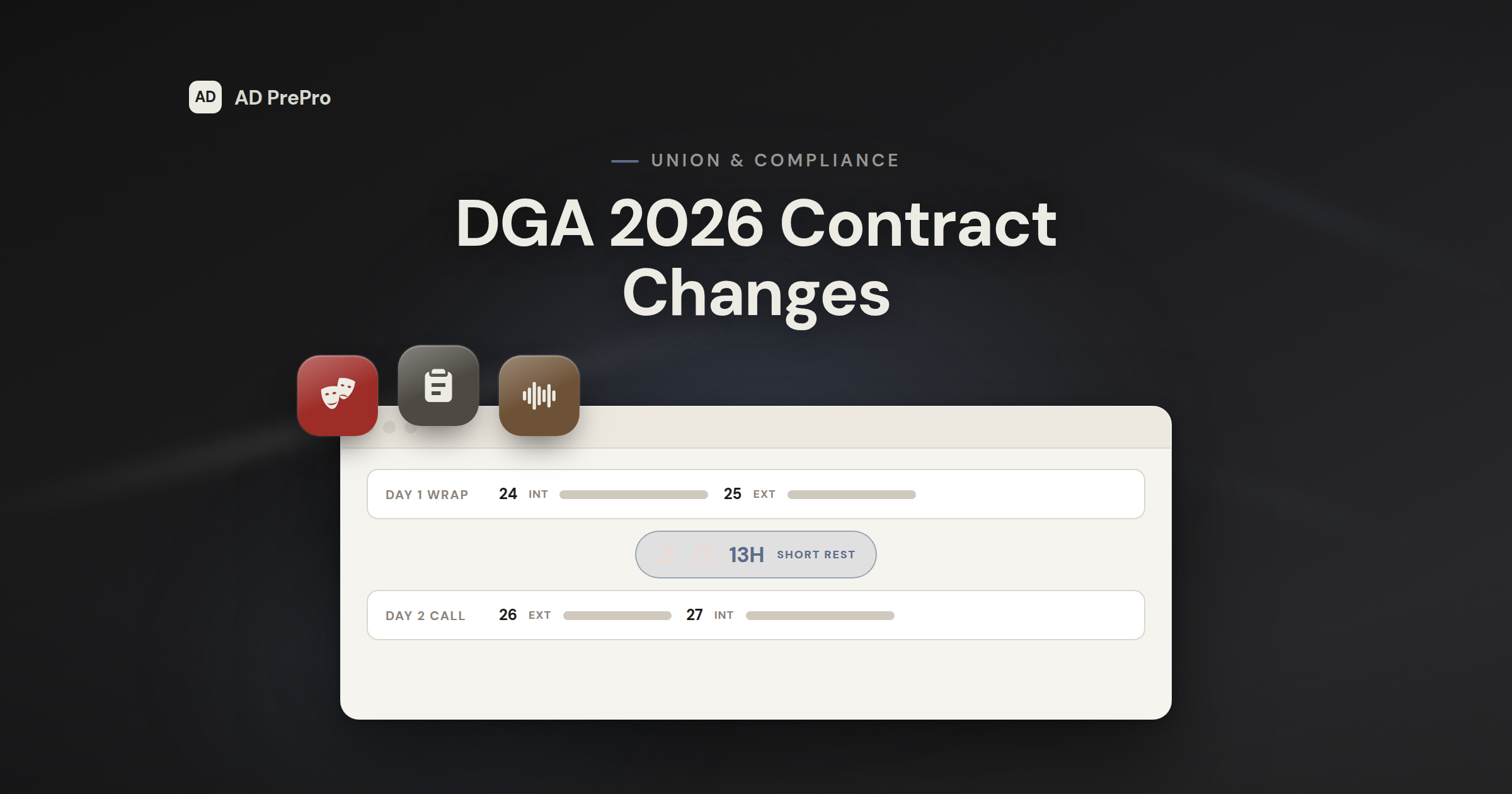
DGA 2026 Contract Changes: What Every 1st AD Should Know
Union & Compliance
The DGA's 2026 contract shortened the multi-cam Extended Workday Trigger from 15 to 13 hours and rewrote how a 1st AD's daily rest period ends. Neither shows up on a rate card.
The 2026 DGA Basic Agreement runs four years, July 1, 2026 through June 30, 2030, and three of its changes actually touch a 1st AD's workday. The multi-camera Extended Workday Trigger drops from 15 hours to 13, effective August 1, 2026. The daily rest period for 1st ADs and Associate Directors now ends at general crew call instead of one hour before the next shooting call, effective July 1, 2026. And Extended Workday pay now counts toward the 14.5% Health fringe, also effective July 1, 2026.
Every writeup of this contract you'll find is aimed at payroll: rate tables, fringe percentages, effective dates in a spreadsheet. None of it answers the question you actually have, which is whether your day just got longer or shorter, and what you need to check before your next multi-cam prep week.
This post covers the Extended Workday Trigger change, the rest period rewrite, the health fringe change, what this means for how you build a shoot day, and the longer list of things that stayed exactly the same.
The Multi-Cam Extended Workday Trigger Drop (15 to 13 Hours)
Multi-camera shows, the sitcom-style format shot in front of an audience or on standing sets, have run a 15-hour trigger for years, longer than every other DGA-covered TV format. Effective August 1, 2026, that trigger drops to 13 hours, matching the number single-camera scripted TV has already been using.
Two fewer hours of runway before the trigger fires sounds small until you count backward from it. A multi-cam day that used to have real slack between the trigger and a realistic wrap now has two hours less of it, on every single shoot day, not just the long ones.
The Rest Period Rewrite: General Crew Call, Not "One Hour Before"
Before this contract, a 1st AD's or Associate Director's daily rest period ended one hour before the next day's shooting call. If shooting call was 7am, their protected rest technically ended at 6am, and that one hour before crew call didn't count against their rest period at all.
Effective July 1, 2026, that rest period now ends at general crew call itself. The one-hour gap that used to sit outside the protected window is gone. If a 1st AD is on set before general crew call, that time now comes out of the same rest period everyone else's turnaround is measured against.
The rest period didn't get longer on paper. It got longer in practice, because the hour that used to not count now does.
This is the same shape of problem turnaround rules solve for cast and crew generally: rest only protects someone if the clock actually stops when they say it stops. A rule that quietly carved out an unprotected hour for the one person often first on set was always going to get closed eventually.
The Extended Workday Pay and Health Fringe Change
Effective July 1, 2026, Extended Workday payments for UPMs, ADs, and Associate Directors now count toward the 14.5% Health fringe. Before this contract, only Completion of Assignment and vacation payments fed that fringe calculation.
It's worth knowing it exists mainly so you recognize it when someone brings it up. It doesn't change anything about how you count hours toward the trigger above, and it doesn't belong on your board.
What Changed vs What Stayed the Same
DGA doesn't publish the same kind of plain-language member breakdown SAG-AFTRA does, which is exactly why this gets lost in rate-card PDFs. Here's the slice that actually touches a 1st AD's schedule.
Reference · DGA 2026 Basic Agreement
What Changed vs What Stayed the Same
That last row is worth saying out loud: the everyday math you already run for a normal shoot day, weekly rest, meal windows, straight overtime, did not move. The three changes above are specific and narrow. They don't rewrite the whole rulebook.
What This Means for Your Shoot Day
If you don't work multi-camera, the trigger change is background knowledge, not a to-do. If you do, or you AD both formats depending on the season, two hours less runway is a real prep-week problem, not a payroll footnote.
Confirm your show's camera format first
The 13-hour trigger only replaces the old 15-hour multi-cam number. Single-camera scripted TV was already at 13 hours and isn't affected by this change at all.
Recount a typical multi-cam day against 13 hours, not 15
A day that comfortably cleared the old trigger with two hours to spare now clears it with none. Walk your usual schedule against the new number before your first prep week after August 1, 2026.
Track the 1st AD's and Associate Director's own rest to general crew call
The old one-hour buffer before crew call is gone. If either of them is on set before general crew call, count that time against their rest the same way you'd count anyone else's.
Leave the health fringe math to your production accountant
It's a real change, but it's a benefits calculation, not a scheduling one. Know it exists; don't try to build it into your board.
Read the actual signed 2026 Basic Agreement before you rely on any of this for payroll
This post, and every other summary of this contract, is a starting point for a conversation with your production accountant or UPM, not a substitute for the agreement your production actually signed.
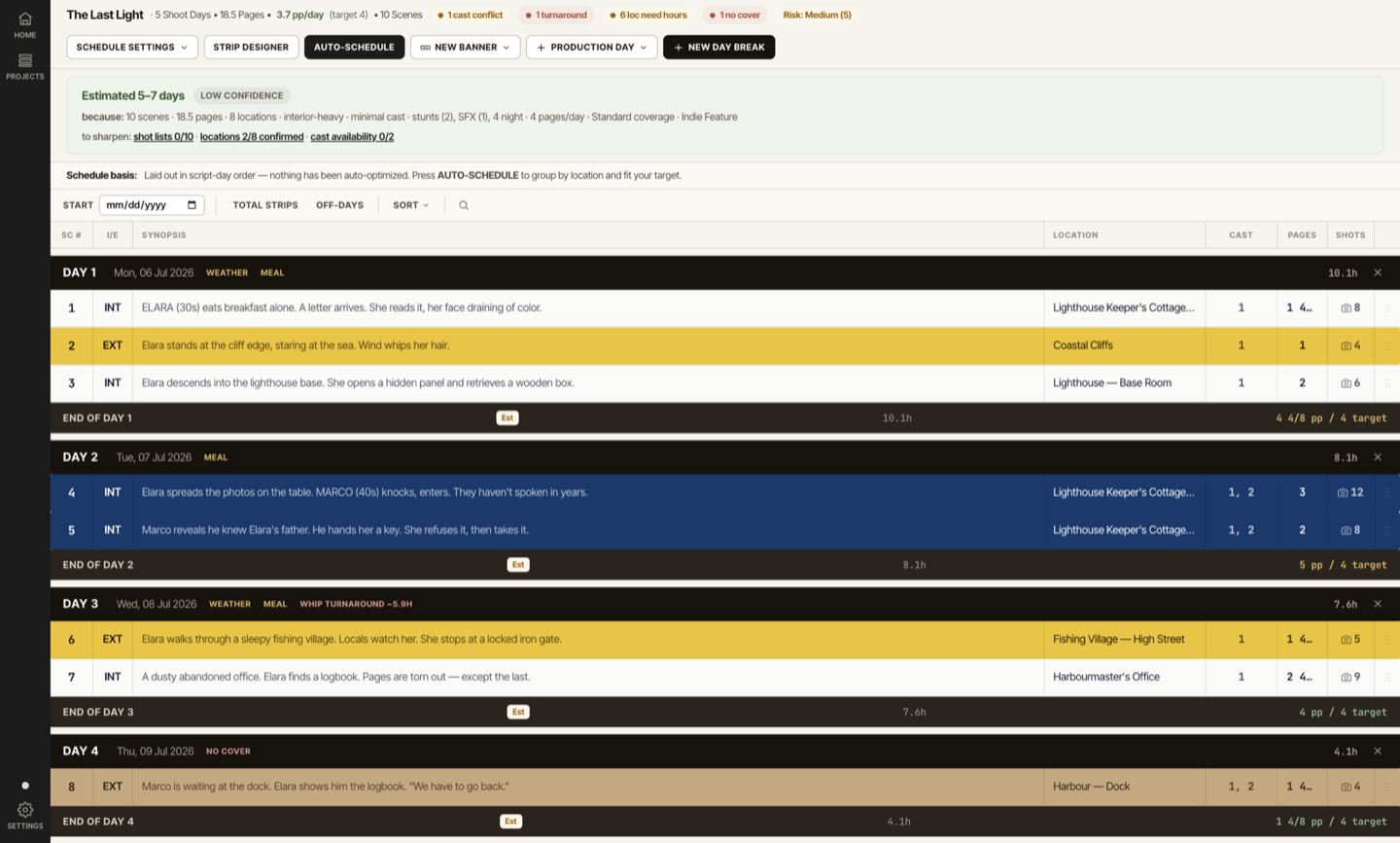
None of this is DGA enforcement. AD PrePro doesn't have a DGA rule engine the way it does for SAG-AFTRA and IATSE turnaround, and it won't tell you when a specific day crosses a multi-cam trigger. What it does is show you the day's real length as you build the schedule, which is the same information you'd need to do that count by hand, just faster.
DGA 2026 Contract Changes FAQ
When did the 2026 DGA Basic Agreement take effect? The agreement's core term runs July 1, 2026 through June 30, 2030. Most of the changes covered here took effect July 1, 2026, except the multi-camera Extended Workday Trigger drop, which starts August 1, 2026.
Does the Extended Workday Trigger change apply to single-camera shows? No. Single-camera scripted TV was already using a 13-hour trigger before this contract. The change only lowers the multi-camera number from 15 hours to match it.
What is an Extended Workday Trigger, exactly? It's the hour mark on a DGA-covered workday past which an Extended Workday payment is owed to the 1st AD and Associate Director. Crossing it triggers a payment obligation. It isn't a hard stop on the workday itself.
Does the new rest period rule apply to 2nd ADs too? The daily rest period change described here is specific to 1st Assistant Directors and Associate Directors under the Basic Agreement. Confirm your own position's terms against the signed agreement rather than assuming a rule written for one role applies to another.
Does AD PrePro enforce DGA rules? No. AD PrePro's red-flag engine reports SAG-AFTRA and IATSE turnaround and union-rule violations. It does not currently enforce DGA-specific thresholds like the Extended Workday Trigger, and this post doesn't claim otherwise.
Where can I read the actual contract language? Start with the DGA's own published Basic Agreement and rate card pages. This post, like any summary, is a starting point for a conversation with your UPM or production accountant, not a replacement for the signed agreement your production is working under.
Two Hours Shorter, One Hour Less Buffer
For multi-cam, the trigger moved two hours earlier. For every 1st AD and Associate Director, the rest period closed the one-hour gap that used to sit outside it. Neither shows up on a rate card, and neither is optional just because it's easy to miss.
AD PrePro tracks the real length of every shoot day as you build the schedule, so a day creeping toward a trigger, DGA, SAG-AFTRA, or IATSE, shows up while you can still fix it. Upload your schedule and see the day length before you lock the board, not after.