6th and 7th Day Premiums: What Every AD Should Know
Union & Compliance
A sixth consecutive day does not look different on the call sheet. It is a real premium for everyone on it, and it started with a schedule nobody checked for the run.
A 6th or 7th day premium triggers the moment someone works a sixth or seventh consecutive day without a day off between them. The sixth day is commonly paid at 1.5 times the rate, the seventh at 2 times, and it applies per person, not once for the whole call sheet.
Nothing about it shows up on a single day's call sheet. A 6th day only exists in relation to the five days before it, so the only way to see it coming is to look at the whole run, and most schedules get built one day at a time.
This guide covers what actually counts as a consecutive day, what the premium costs and why nobody can quote you an exact dollar figure, the difference between SAG-AFTRA, IATSE, and non-union, the schedule move that resets the count, and how to catch a run before it becomes a premium.
What a 6th and 7th Day Premium Actually Is
The standard production workweek is five days out of seven, with the other two set aside as days off. Work a sixth consecutive day past that and the premium kicks in. Work a seventh in a row and it steps up again.
That last point is where most schedules quietly drift into it. A crew that never gets two clean days off inside a seven-day stretch is racking up a run, even if nobody ever labeled a day 'the sixth day' on purpose.
What It Costs (and Why No Blog Post Can Give You a Number)
The sixth consecutive day is commonly paid at 1.5 times the base rate for the hours worked. The seventh steps up again, commonly to double time. Both are per person, per occurrence, so three people short on the same week are three separate premiums, not one.
What stays constant is the shape of the problem: the cost is not the day itself, it is every hour on that day paid at a multiplier instead of straight time. A long sixth day is far more expensive than a short one, which is exactly why catching it in prep matters more than catching it after.
SAG-AFTRA, IATSE, and Non-Union: Who Actually Owes It
Both SAG-AFTRA performers and IATSE crew work under the same five-out-of-seven shape, with the premium starting on the sixth consecutive day and stepping up on the seventh. The thresholds match. The rates and any caps still come from the specific agreement, not the union name alone.
Reference · 6th/7th Day Thresholds
When the Premium Kicks In
Non-union has no automatic sixth or seventh day rule at all. That does not make it free to ignore. If it is not written into the deal memo, there is no number to fall back on when a run happens, which is its own kind of expensive when a crew member asks what they are owed.
The Move That Resets the Count
Producers are allowed to shift which two days of the week count as the days off, on a week-by-week basis. The rule only cares that two real days off happen inside a seven-day stretch, not that they fall on a Saturday and a Sunday.
The premium is not a penalty for working a hard week. It is what happens when nobody checked whether the week actually had two days off in it.
This is also why a single-day view of the schedule hides the problem. A stripboard built one day break at a time can look completely reasonable and still be five days into a run nobody counted, because the count only exists across days, not on any one of them.
How to Catch the Run Before It Is a Premium
The check itself is simple: count consecutive worked days per person, watch for the sixth, and confirm a real day off before the run gets long. The part that is not simple is doing it by hand, per person, on a schedule that keeps moving until the board locks.
Count per person, not per company
A background player who joined the show on day 3 has a different run than a lead who has been on since day 1. The count resets individually, so it has to be checked individually.
Watch the run as you build, not after
Every added shoot day extends every open run. Check it while you are still deciding whether to add the day, not after the board is locked and a producer is asking about the cost.
Confirm days off are real, not just unscheduled
A hold day where someone is still on call is not the same as a true day off for this count. If they can be called in, verify whether it actually breaks the run before you assume it does.
Recheck after any schedule move
Moving one scene can push a shoot day earlier or later and change who is on which side of a break. A run that was clean on Monday can be five days deep by Thursday after two unrelated moves.
Flag it against turnaround at the same time
A long run and a short rest gap often show up together on the same stretch of board. Check both while you are looking, instead of catching one and missing the other.
Free 6th and 7th Day Reference
The reference card above is the version worth keeping next to your board: the five-day default, both premium steps, and the non-union gap, in one place instead of a union website, a payroll glossary, and a contract PDF.
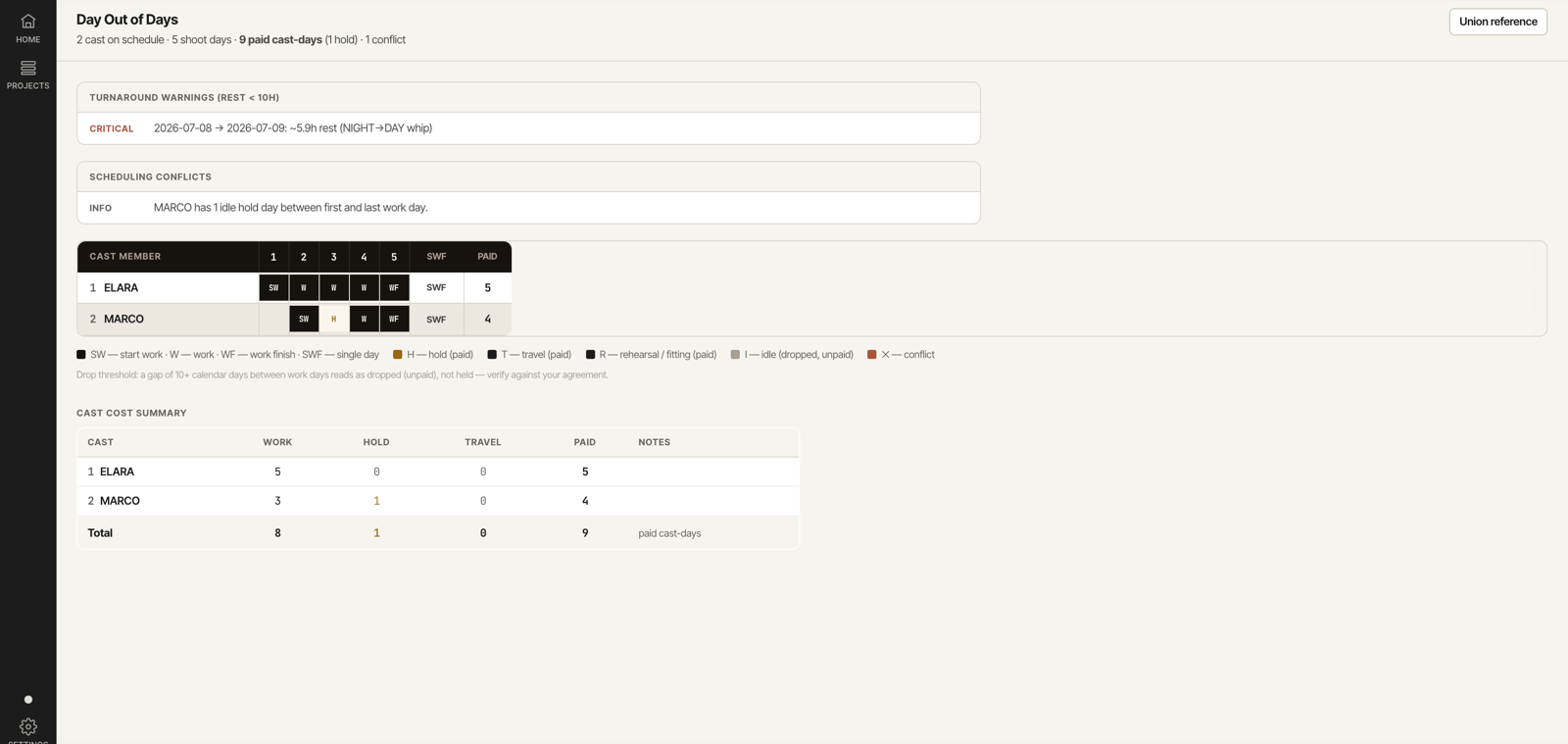
Pair it with the Day Out of Days you are already keeping. A DOOD that tracks every cast member's work days across the whole schedule is the same view that makes a consecutive-day run visible at a glance, instead of something you reconstruct from memory on a Friday.
6th and 7th Day Premiums FAQ
What counts as a 6th consecutive day? The sixth calendar day someone works in a row with no day off in between, regardless of which day of the week it falls on. A single genuine day off resets the count back to zero.
Does the premium apply to cast and crew the same way? The five-out-of-seven shape and the sixth and seventh day thresholds are the same for SAG-AFTRA performers and IATSE crew. The exact rates and any dollar caps still depend on the specific agreement each is working under.
Do the two days off have to be a weekend? No. The rule only requires two real days off inside a seven-day stretch. Producers can shift which two days those are from week to week, as long as the pattern holds.
Does non-union have to pay 6th or 7th day premiums? Not automatically. There is no default rule the way there is for SAG-AFTRA or IATSE. If it matters to your production, it has to be written into the deal memo, or there is nothing to point to when the question comes up.
Is a hold day the same as a day off for this count? Not necessarily. A hold day where someone can still be called in is different from a confirmed day off. Verify the terms of the hold before assuming it breaks a consecutive run.
Can software catch a 6th or 7th day run before it happens? Yes, if it tracks consecutive worked days per person as the schedule is built, not just per calendar week. That is the difference between seeing the run while you can still add a day off and finding it on a cost report after the day already happened.
Check the Run, Not Just the Day
You now have the actual mechanics: five days on, a premium starting on the sixth, another step on the seventh, and a count that resets on any real day off, whichever day of the week it falls on. The math is simple. Watching it per person across a moving schedule is the part that isn't.
AD PrePro tracks every cast and crew member's run of consecutive shoot days on the Day Out of Days grid as you build the schedule, and flags a sixth or seventh day before it is locked in. It will not decide the schedule for you. It just makes sure you are the one who catches the run first.