AI Script Breakdown: An Honest Review From a Working AD
Script Breakdown
AI script breakdown really does save hours. It also really does miss things. Here's exactly which categories to trust, which to check, and the review pass that catches the rest.
Every AI script breakdown tool says the same thing: upload a script, get a full breakdown back in under a minute. That part is true. What the landing page skips is what you're actually getting: a fast first pass with real gaps, not a finished document.
Run an AI breakdown against a scene you'd tag by hand and the pattern shows up fast. The mechanical tags land close to perfect: cast names, INT/EXT, day and night, any prop or vehicle the script names outright. The judgment calls, the ones that decide whether your schedule actually holds, are still yours.
This is the honest version: what AI script breakdown gets right, exactly where it still falls short, and the five-minute check that keeps a missed element from becoming a bad day on set.
What "AI Script Breakdown" Actually Means
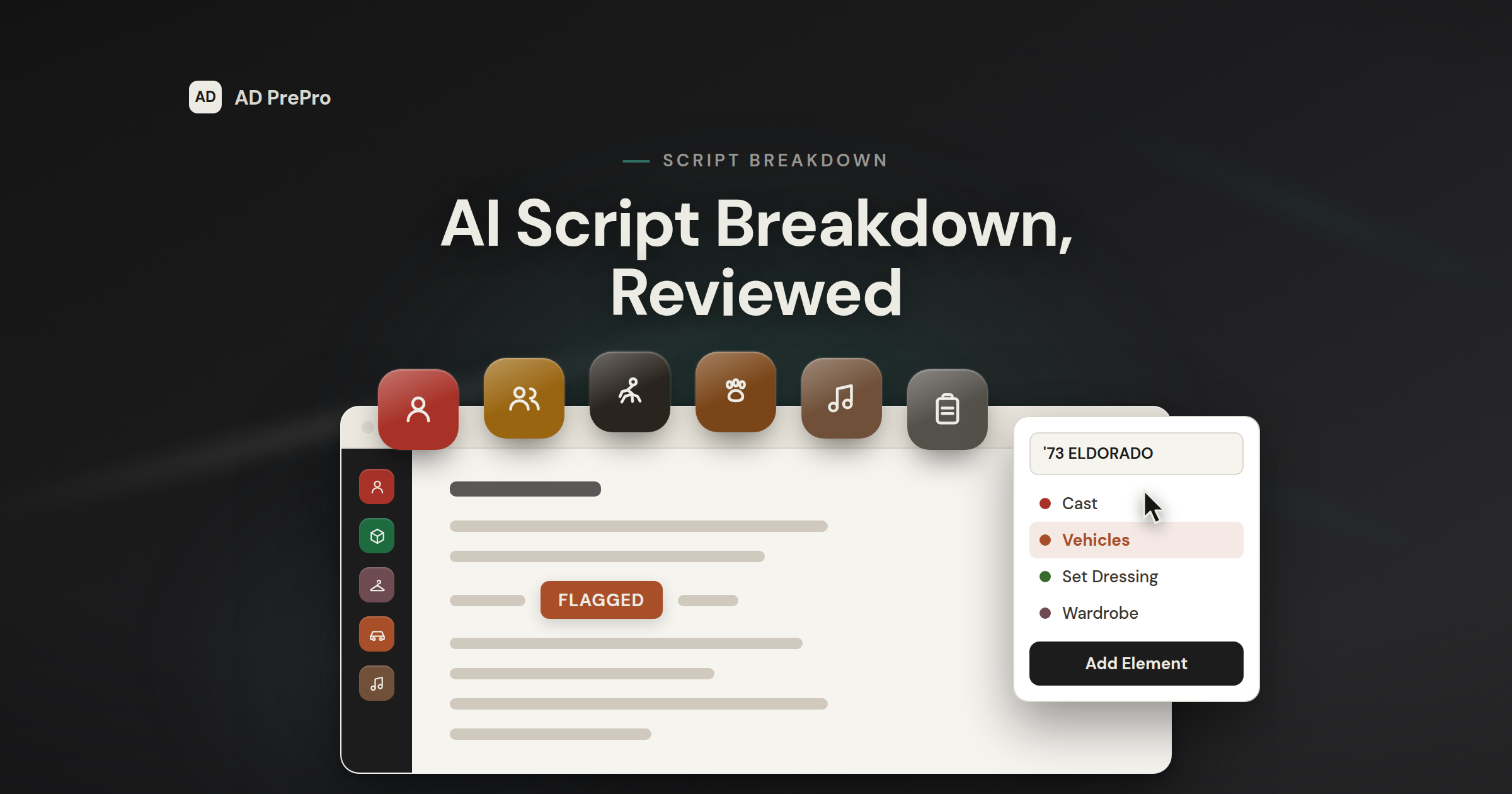
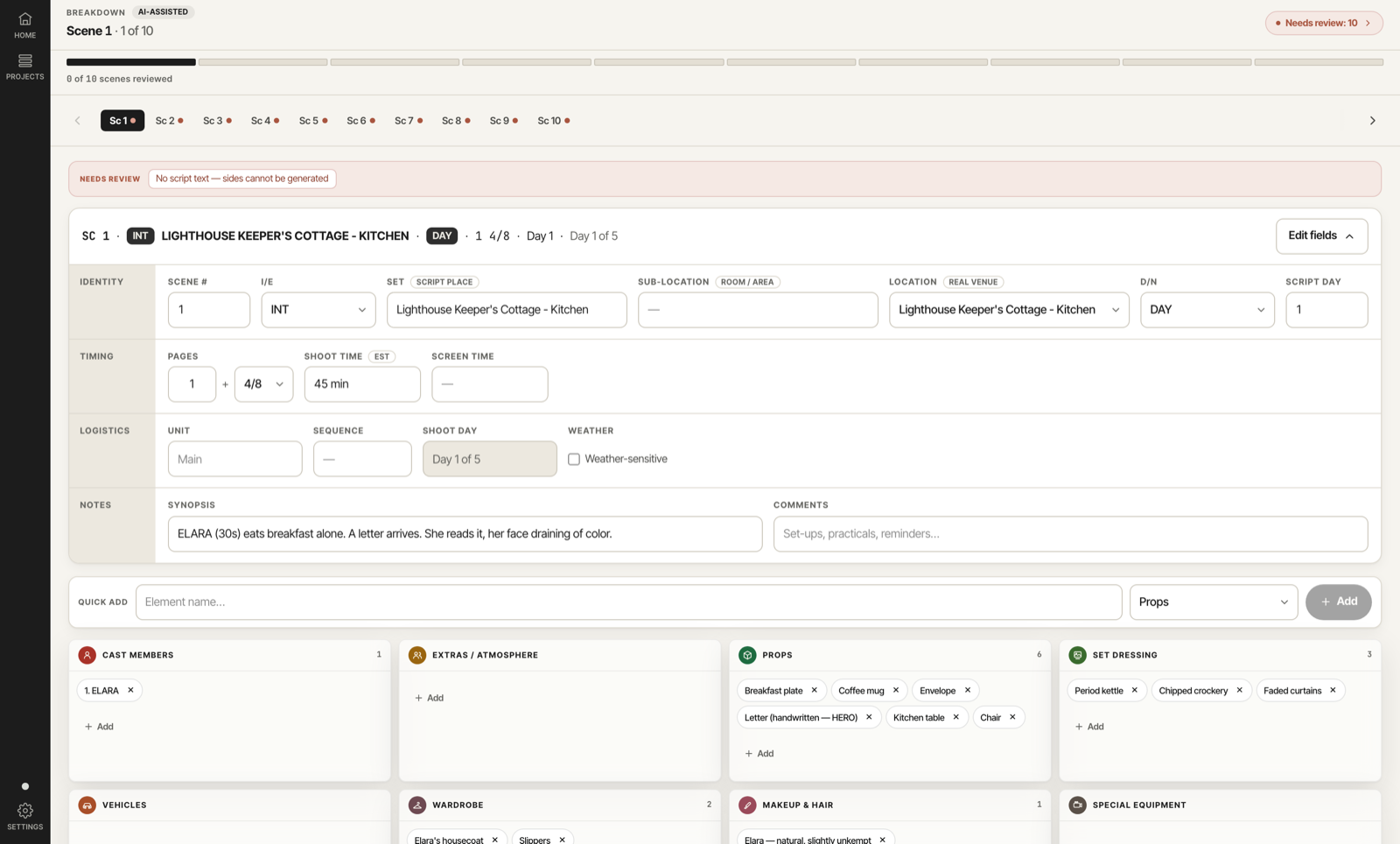
AI script breakdown means a model reads an uploaded script and tags every scene by element category on its own: cast, extras, props, wardrobe, vehicles, stunts, effects, and the rest. It replaces the first pass of highlighting a printed script by hand, not the whole job.
The pitch sounds like a shortcut around the whole job. It isn't. It's a shortcut around the tedious 80%, the part where you're scanning for character names and sluglines instead of thinking about the schedule those scenes have to fit into.
What AI Actually Gets Right
Point AI script breakdown at a clean script and it earns its keep fast. On a full feature, that's a few hours handed back before lunch.
- Cast: every named speaking character, tagged in every scene they appear, not just the first
- Sluglines: INT/EXT and day/night, read straight off the header, scene by scene
- Named props and vehicles: anything the script states outright, like "she grabs the keys" or "his '73 Eldorado"
- Scene inventory: the raw scene count and structure, ready to hand to a schedule
That's the mechanical layer, and it's genuinely reliable. It's also the layer that used to eat a full day of a 1st AD's prep, one highlighter color at a time.
Where It Still Falls Apart
The gap isn't in what the script says. It's in what the script assumes you already know how to read.
"The diner is packed." No tool flags a background count from that line on its own, but you need a real number weeks out for casting and wardrobe to plan around.
"She pulls a knife." That's a prop, probably a stunt coordinator, and possibly a safety officer, none of it stated as those categories in the sentence itself.
"Smoke fills the hallway." A practical effect and a safety concern, buried in an action line the AI reads as scene description rather than a tag to raise.
How Reliable Is Each Category, Really
Not every category fails the same way or the same amount. Treat this as your triage list for a review, not a reason to distrust the whole breakdown.
Reference · AI Breakdown Reliability
What to Trust and What to Check
The 5-Minute Review Before You Trust It
Before an AI breakdown becomes the foundation for your schedule, run it through a fast check. This isn't a full re-read. It's a targeted pass over the categories that actually fail.
- Scan every scene for background counts the script implies but never states as a number
- Check action lines for stunts or effects written as description, not flagged as a category
- Confirm every low-confidence tag the tool flagged, not just the ones that look obviously wrong
- Spot-check three scenes by hand against the AI output before you trust the rest of the script
- Read night exteriors and minor-heavy scenes twice, they carry the most hidden elements
What a Missed Element Costs You Downstream
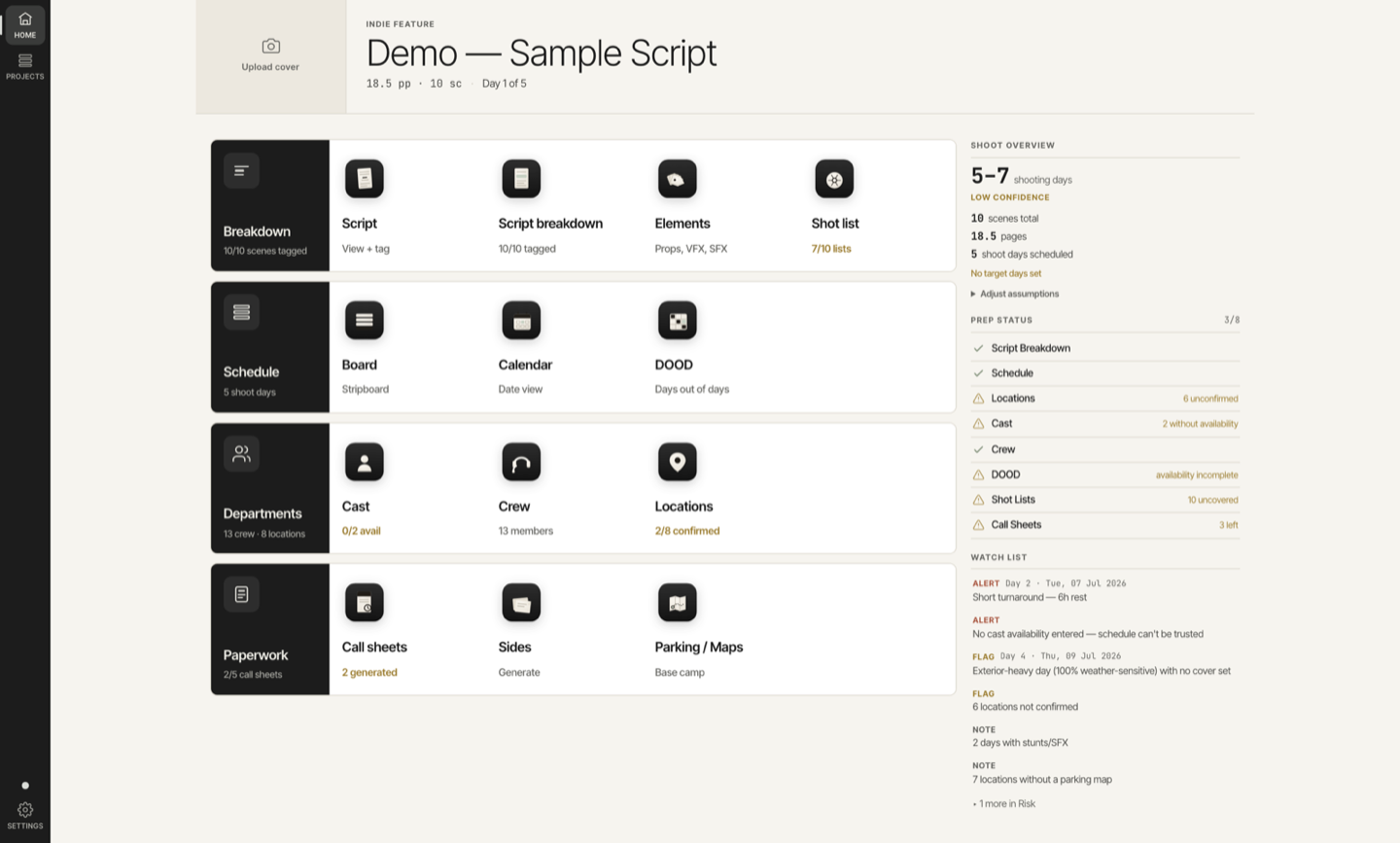
A script breakdown isn't a standalone document. It's the raw material for your stripboard, your Day Out of Days, and your call sheet, so an error in the breakdown doesn't stay contained to the breakdown.
Miss a background count and wardrobe finds out on the day, not three weeks out when there's still time to fix it. Miss a buried stunt and you're explaining to a producer why the schedule never budgeted rehearsal time for it. Miss what a night exterior implies and you're staring down a forced call nobody saw coming.
So, Does It Actually Work?
Yes, with a real qualifier. AI script breakdown does the mechanical 80% honestly and fast: named cast, sluglines, explicit props and vehicles, tagged across every scene in minutes instead of a day.
It does not replace the judgment that catches the implied 20%: background counts, buried stunts, safety needs the script never labels as such. That's still the 1st AD's job, and no tool worth using pretends otherwise.
The tools worth trusting are the ones that admit what they missed. A breakdown that flags its own low-confidence tags is more useful than one that quietly guesses and hopes you catch it before the call sheet goes out.
Use it as a fast first pass, not a finished breakdown. Review the flags, trust the mechanical tags, and keep doing the judgment calls yourself.
AI Script Breakdown FAQ
Is AI script breakdown accurate? For the mechanical layer, cast, sluglines, and explicitly named props or vehicles, yes, close to accurate out of the box. For implied elements like background counts and unlabeled stunts, plan on reviewing and correcting every scene yourself.
What does AI still miss in a script breakdown? Anything the script implies instead of states: background counts, a stunt written as plain action, an effect described in a sentence instead of tagged as SFX. These are the categories worth a manual pass every time.
How long does an AI script breakdown take? A full feature comes back in minutes instead of the day or two a hand breakdown takes. Budget a few more hours after that for review, not zero, because the first pass is a draft, not a finished breakdown.
Do I still need to review an AI breakdown by hand? Yes, every time. Sort by confidence, check the flagged items first, then spot-check a few scenes the tool marked as high confidence. That combination catches most of what slips through.
Can AI script breakdown replace a 1st AD? No. It replaces the highlighter, not the judgment. The AD still reads for what a scene implies, flags the risk, and makes the calls that decide whether a shoot day actually works.
The Honest Bottom Line
AI script breakdown saves real hours on real scripts. It also misses real things, the same categories every time: implied action, background counts, stunts and effects buried in a sentence instead of tagged. Know which is which and it's a genuine upgrade to your prep, not a replacement for it.
AD PrePro runs the same honest pass described here: it tags every element it can catch with confidence, flags what it can't, and hands you a breakdown that's ready for your review instead of pretending to be finished. Upload a script and see exactly what it flags.