1/8 Page Film Scheduling Explained: How ADs Count Pages
Scheduling
One-eighth of a page is the unit your entire shooting schedule runs on. Here's how to count it, write it, and turn it into a day that actually finishes.
One-eighth of a page is the smallest unit your shooting schedule runs on. Nobody teaches you how to count it in film school. You learn it on your first prep, usually when someone hands your page count back with a correction.
The math sounds simple: split a page into eight equal strips and count how many a scene fills. It gets messy fast, when a scene is mostly white space, when eight scenes share one page, or when a revision shifts every page number the week before you shoot.
This guide covers how to count eighths correctly, how to write the shorthand, how those counts turn into a realistic shooting day, and the mistakes that throw a schedule off before day one even starts.
What an Eighth Actually Is
A script page is roughly eight inches of usable text, and the old rule of thumb still holds: one page is about one minute of screen time. Split that page into eight even strips and each strip is one-eighth. A scene that fills three strips is 3/8 of a page, no matter how much dialogue is packed inside it.
Every scene gets a page count in eighths, not a page number. That count follows the scene everywhere: the breakdown sheet, the stripboard, the Day Out of Days, the shot list, and the call sheet. Get it wrong once and it's wrong in five places.
How to Count Eighths on the Page
Don't guess the count from a glance. A scene's eighths decide how it fits into a day, so measure it the same way every time.
Split the page into eighths
Mark the page in half, then quarters, then eighths, about one inch per strip on a standard screenplay page. Some ADs still use a ruler; most eyeball it after a few scripts.
Count every strip the scene touches
Count every strip the scene's text fills, including one with just a line or two. A scene that starts three-quarters down one strip and finishes into the next still claims both.
Round up, never down
A scene that fills even part of a strip counts as that full eighth. Nobody builds a day around 7 and 7/8ths of an eighth.
Write the total as pages plus eighths
A scene running two full pages and three strips is written 2 3/8, not 2.375 and not 'about two and a half.'
How to Write Eighths Shorthand
You'll see eighths written two ways on a stripboard or breakdown sheet: a fraction tacked onto a whole number (2 3/8), or, for anything under a page, just the fraction on its own (4/8). Both mean the same thing: whole pages, plus whatever's left over.
| Notation | What it means |
|---|---|
| 1/8 | One strip, about one inch of text |
| 4/8 | Half a page |
| 8/8 | One full page |
| 2 3/8 | Two full pages plus three strips |
Reference · The Page in Eighths
One Page, Eight Strips
- 1/8
- 2/8
- 3/8
- 4/8
- 5/8
- 6/8
- 7/8
- 8/8
Turning Eighths Into Pages Per Day
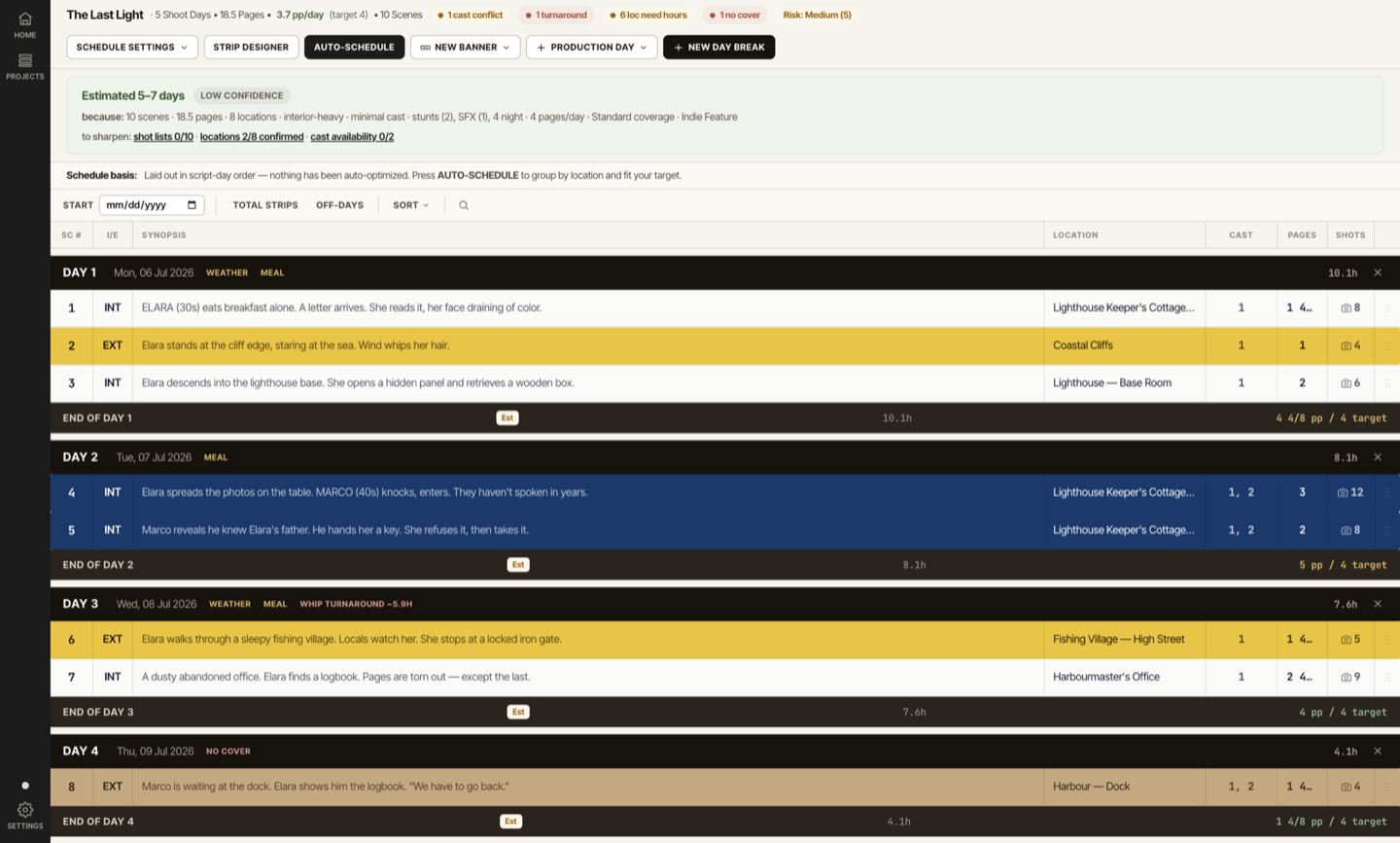
Once every scene has an eighths count, add them up by shoot day. That daily total is the real measure of what you're asking the crew to do, more honest than counting scenes or counting hours.
There's no fixed number that works for every show. A dialogue-heavy indie day can run five or six pages. A day with stunts, night work, or a company move might clear one or two pages, and that's a full day done right.
| Day type | Typical pages |
|---|---|
| Dialogue-heavy, single location | 4 to 6 pages |
| Mixed exteriors, some company moves | 2 to 4 pages |
| Stunts, night work, effects, or minors | 1 to 2 pages |
| Studio tentpole, heavy VFX | Often under 1 page |
Mistakes That Throw the Count Off
The eighths system is simple. Most of the ways it goes wrong come from skipping a step, not from the math itself.
- More than eight scenes on one page: short scenes crammed onto a single page still each get their own eighths count. Count what belongs to each scene, not what fits on the page.
- Treating page count as shoot time: a page is a rough proxy for one minute of screen time, not for how long the day takes. Setup, company moves, and meals live outside the eighths entirely.
- Eyeballing a scene near the day's edge: eyeballing is fine for a two-line scene. Measure the ones that decide whether a scene fits today or slides to tomorrow.
- Page counts pulled from the locked script, not an earlier draft
- Every scene's eighths counted individually, even on a crowded page
- Complex eighths (stunts, night, minors, company moves) weighted heavier than the raw number
- Daily total checked against the day's realistic pages-per-day range before you lock it
Free Page Count Reference Card
Print this one and keep it in your prep binder. Our free page count reference card lays out the eighths shorthand, the strip diagram above, and the pages-per-day ranges by day type, all on one page.
It's the same math the app runs automatically once your script is broken down, so if you move from paper to a tool later, the numbers already match.
1/8 Page Scheduling FAQ
What is 1/8 of a page in a script? One of eight equal strips a standard screenplay page divides into, about one inch each. It's the smallest unit used to measure a scene's length for scheduling, independent of how many lines of dialogue the scene contains.
How do you count eighths on a page? Mark the page into eight even horizontal strips, then count how many strips a scene's text fills, rounding any partial strip up to a full eighth. Write the result as whole pages plus a fraction, like 2 3/8.
How many pages does a movie shoot in a day? It depends on the day. A dialogue-heavy day in one location can run four to six pages, while a day with stunts, night work, or a company move often lands at one to two pages, and both can be a full, well-run day.
What happens when more than eight scenes are on one page? Each scene still gets its own eighths count based on how much of the page its text occupies. A page can hold several short scenes that each claim just an eighth or two, adding up to more than 8/8 across the whole page once every scene is counted.
Do camera directions and parentheticals count toward the eighths? Yes. The count is based on how much vertical space the scene occupies on the page, action lines, dialogue, and parentheticals included, not on dialogue alone.
Why do productions measure in eighths instead of just page numbers? Page numbers tell you where a scene sits in the script. Eighths tell you how long it is, which is what a schedule actually needs. A 1/8 scene and a 7/8 scene can share a page number's neighborhood and still take wildly different amounts of time.
Count It Once, Trust It All Day
You now have the method: split the page into eighths, count every strip a scene fills, round up, and add the day's total against a realistic pages-per-day range for what you're actually shooting.
AD PrePro counts every scene's eighths automatically the moment your script is broken down, then carries that count into the stripboard and Day Out of Days so a day's total is never a guess. Upload a script and start with the math already done.